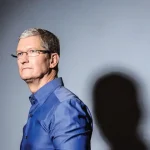
Apple CEO consistency is the phrase that best defines the transition from Tim Cook to John Ternus. Apple announced that Cook will become executive chairman of the board and that Ternus, currently senior vice president of Hardware Engineering, will become CEO on September 1, 2026. The company said the transition was approved unanimously by the board and follows a long, careful succession process. That wording matters because Apple is not presenting this as a sudden power shift. It is presenting it as continuity at the top of one of the most influential companies in the world.
That framing is exactly what Apple needs. After 15 years under Cook, the company is not looking for theatrical reinvention. It is managing a handoff inside a business with a market value around $4 trillion, more than 2.5 billion active devices, millions of developers, thousands of suppliers, hundreds of stores, and shareholders who expect discipline before drama. Reuters described Cook’s tenure as one defined by operational smoothness, supply-chain mastery, and a market value that grew to about $4 trillion. Ternus inherits that standard, not a blank page.
The most important point is pace. John Ternus may bring a stronger product-engineering profile into the CEO role, but the next phase is unlikely to look like a personal takeover of innovation. Apple does not need a CEO with “full hands” over every product decision in the visible, Steve Jobs-era sense. It needs a CEO who can protect the system Apple has built: internal relationships, executive discipline, product timing, services growth, public affairs, policy strategy, supply-chain resilience, and a culture that can keep moving without scaring the market.

Consistency Is the Business Model
Cook’s Apple became the most valuable consumer technology company in the world not by abandoning innovation, but by making it operationally repeatable. That is a different kind of leadership than the one associated with Steve Jobs. Jobs shaped categories through taste, urgency, and direct product pressure. Cook shaped Apple through scale, timing, services, supply chains, margins, and a management rhythm that could carry the company through more than a decade of iPhone expansion, Apple silicon, Apple Watch, AirPods, Services, and global retail growth.
Ternus arrives inside that architecture. He is not being asked to rescue a broken company. He is being asked to maintain a system whose influence reaches far beyond its own revenue. Apple’s hardware decisions affect suppliers, semiconductor partners, component markets, app developers, accessory makers, carriers, media companies, payment networks, advertisers, schools, hospitals, and governments. A company with that level of economic reach cannot treat a CEO change like a brand reset.
That is why the comparison with Jobs’ final years is useful, but only if handled carefully. When Jobs stepped down as CEO in 2011, his influence did not disappear from Apple overnight. Product roadmaps, internal habits, executive relationships, and cultural expectations carried forward for years. Cook’s move to executive chairman creates a different but related form of continuity. Apple has made clear that Cook is not leaving the company’s orbit. He is moving from day-to-day CEO leadership into board leadership, where his presence can continue supporting the transition and reinforcing institutional memory.
That matters for Ternus because Apple’s next CEO does not need to prove independence through abrupt change. The stronger move is to show command by preserving the company’s cadence. Investors will watch how the leadership team handles product launches, AI integration, Services momentum, China exposure, India growth, public policy pressure, developer relations, and supply-chain commitments. The early signal they will want is not disruption. It is stability.
Apple also moved quickly to reinforce the hardware structure around the transition. On the same day as the CEO announcement, Apple named Johny Srouji chief hardware officer, expanding his role to include Hardware Engineering as well as Hardware Technologies. That decision matters because it prevents Ternus’ move upward from leaving a vacuum in the engineering organization he previously led. Apple is clearly trying to make the transition feel internally complete before it becomes externally dramatic.

John Ternus Does Not Need to Become Steve Jobs
The obvious temptation will be to cast Ternus as a return to product-led Apple. That framing is understandable because Ternus comes from hardware engineering and has spent more than two decades inside the company. Apple’s announcement identifies him as the executive who most recently oversaw Hardware Engineering, while Reuters notes that he has played a central role in major product lines across Mac, iPad, AirPods, and iPhone.
But Apple does not need Ternus to imitate Jobs. That would be the wrong lesson. The company is too large, too global, and too structurally different from the Apple Jobs handed to Cook. Apple now runs a services business at massive scale, manages regulatory pressure across the U.S., Europe, China, India, and other regions, supports a global developer economy, maintains a complex supply chain, and carries investor expectations attached to one of the largest market caps in history.
Ternus’ product background still matters deeply. It gives Apple a CEO who understands hardware architecture, engineering tradeoffs, manufacturing realities, and the product culture that made the company powerful in the first place. That may help Apple as it navigates AI devices, spatial computing, new Macs, iPhone form-factor changes, wearables, and longer-term hardware categories. Reuters reported that analysts see his appointment as a signal that Apple may focus on fusing AI into existing devices rather than chasing a separate AI-first product category. That reading fits Apple’s historical pattern.
Still, the next couple of years should be read through continuity first. Cook’s Apple has already built long product roadmaps. Hardware pipelines do not reset on a CEO’s first day. Supply commitments, chip plans, manufacturing agreements, software schedules, and services strategies extend across years. Ternus will influence those systems, but he will not be starting from zero.
That is why “consistency” remains the central word. Apple innovation is not only a person standing on stage with a new device. It is a multi-year internal process linking design, silicon, software, operations, secrecy, marketing, retail training, carrier timing, developer support, and financial discipline. Ternus’ first challenge is to prove that the system keeps working under his name.

The Scale Demands Discipline
Apple economics is consistency. The company’s value is not only in the next iPhone or the next Mac. It is in the belief that Apple can keep doing this every year: ship, support, refine, expand, and protect the ecosystem without losing cultural control. That expectation is why a leadership transition at Apple is not comparable to an ordinary CEO change.
At a $4 trillion scale, even small signals carry weight. A shift in product timing can affect suppliers. A services policy change can affect developers. A privacy decision can affect advertisers and regulators. An AI move can affect semiconductor demand. A manufacturing announcement can affect regional economies. Apple’s influence moves through direct revenue, partner ecosystems, app markets, retail channels, payments, media, and the behavior of hundreds of millions of customers.
That is also why public affairs and policy will be central to the Ternus era. The next CEO will not only manage products. He will manage a company under constant regulatory attention: App Store rules, payment systems, privacy protections, repairability laws, AI governance, supply-chain exposure, and market power investigations. Cook became one of the most effective technology executives in the world partly because he understood that Apple’s operations, values language, and policy stance had to move together. Ternus inherits that model.
The internal relationships matter just as much. Apple’s executive culture depends on coordination between hardware, software, services, design, operations, retail, legal, finance, communications, and environmental teams. The company looks unified from the outside because its internal machinery is trained to converge before the public sees the result. A CEO transition can expose weaknesses in that machinery if it is not handled carefully. Apple’s announcement suggests the opposite: a planned, board-approved handoff with Cook staying close and Srouji taking a larger hardware role.
The Ternus era will be judged not by how loudly it begins, but by how cleanly it preserves Apple’s rhythm while adding its own technical emphasis over time. The company can afford ambition. It cannot afford disorder. That is the real weight of the transition.
Apple’s next chapter may bring more aggressive hardware moves, deeper AI integration, new device categories, and a renewed emphasis on engineering culture. But the first test is simpler: keep the company feeling like Apple. Keep the roadmap intact. Keep investors calm. Keep teams aligned. Keep services growing. Keep policy controlled. Keep product launches precise. In a company whose economic influence now reaches across nearly every developed technology market, consistency is not caution. It is the operating system.