

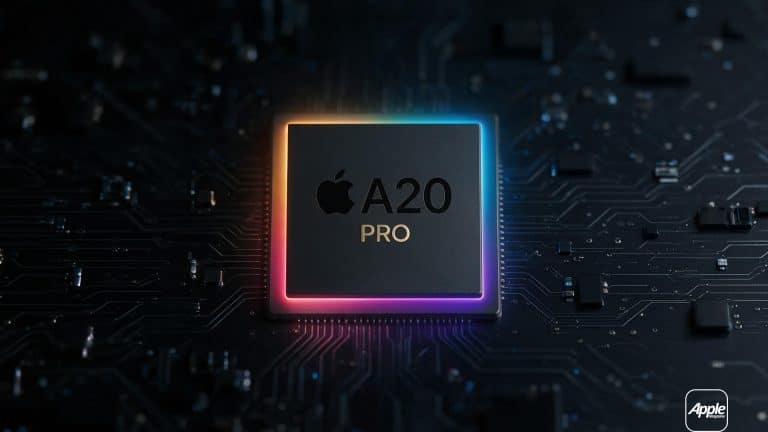
The A20 chip expected to define the iPhone 18 lineup could deliver a more substantial technical jump than Apple’s usual annual processor update. Reports point to two major upgrades: production using TSMC’s first-generation 2-nanometer process and a new packaging method that places system memory closer to the processor.
Apple has not announced the chip or confirmed which devices will receive each version. The A20 Pro is expected to debut during the September launch cycle inside the iPhone 18 Pro and iPhone 18 Pro Max, with Apple’s first foldable iPhone also associated with the advanced processor.
The regular A20 could follow in other members of the same generation, including the standard iPhone 18 and iPhone 18e, which are reportedly planned for the first half of 2027. An eventual iPhone Air 2 may also use an A20-series configuration, although reports indicate that Apple delayed the second-generation Air from its original fall 2026 schedule.
Regardless of the exact model distribution, the A20 generation appears designed to improve how the iPhone processes large quantities of data while reducing the energy required to complete those operations.
A20 Chip Moves From 3nm to 2nm
The first major upgrade is expected to be Apple’s transition from TSMC’s 3-nanometer manufacturing technology to its N2 process.
Current A-series chips use FinFET transistors, a structure that has supported several generations of performance and efficiency improvements. TSMC’s N2 process introduces gate-all-around nanosheet transistors, giving the chipmaker greater control over the flow of electrical current.
Better current control can reduce leakage and allow transistors to operate more efficiently. TSMC says N2 can provide approximately 10% to 15% more performance at the same power level or consume 25% to 30% less power while delivering comparable performance.
Those figures describe the manufacturing process rather than the finished A20 chip. Apple will determine how to divide the available gains among CPU performance, graphics, machine learning, camera processing and battery efficiency.
A smaller process also allows more transistors to fit within a similar physical area. Apple could use that density to expand the Neural Engine, increase graphics resources, enlarge internal caches or add specialized hardware without making the processor significantly larger.
The transition may be particularly useful for the iPhone 18 Pro models, which are expected to combine more advanced cameras, expanded satellite communication and increasingly complex software. Each of those systems competes for processing power, memory bandwidth and battery capacity.
Improved efficiency could allow the A20 Pro to sustain demanding tasks for longer periods without creating as much heat. That would support extended gaming, high-resolution video recording, computational photography and Apple Intelligence features running directly on the device.


WMCM Packaging Changes How the Components Connect
The second upgrade involves the physical assembly of the chip rather than the transistors inside it.
Apple is expected to adopt TSMC’s Wafer-Level Multi-Chip Module packaging, commonly known as WMCM. The technology can integrate separate components, including the processor and DRAM, within a more tightly connected package.
Recent A-series chips use Integrated Fan-Out packaging, with memory positioned above the processor through a package-on-package design. WMCM could give Apple greater flexibility in arranging the components while creating shorter and more efficient electrical connections.
Reducing the distance traveled by data can improve latency and lower energy consumption. The CPU, GPU, Neural Engine and image signal processor all depend on frequent access to memory, especially when several systems are working on the same task.
The packaging method may also reduce the amount of logic-board space occupied by the processor and memory assembly. Space recovered inside an iPhone could be allocated to battery capacity, camera equipment, cooling hardware or communications components.
This advantage may be particularly useful for the foldable iPhone and a future iPhone Air 2, where internal space is constrained by thin enclosures, hinges or compact battery arrangements.
Memory Becomes Central to Apple Intelligence
The A20 chip’s two reported upgrades arrive as memory performance becomes increasingly significant across the iPhone lineup.
Apple Intelligence features do not depend exclusively on the Neural Engine. Language, image and personal-context operations may distribute work among the CPU, GPU and machine-learning accelerators while retrieving information from system memory.
A faster processor can lose part of its advantage when it has to wait for data. Bringing memory closer through WMCM packaging could improve communication among the individual computing units and reduce the power consumed during those transfers.
This may benefit functions such as Visual Intelligence, image generation, writing assistance, live translation, computational photography and the next generation of Siri. Requests involving several apps or personal data may require the device to process multiple sources before presenting an answer or completing an action.
Some complex requests will continue to use Private Cloud Compute or approved outside models. More efficient local hardware gives Apple greater freedom to perform sensitive or frequently used operations directly on the iPhone.
The 2nm process complements that approach by reducing the energy consumed while the models are running. Local processing has limited value on a mobile device when it quickly drains the battery or generates enough heat to reduce performance.


A20 Pro Leads the September Launch
Apple is expected to introduce the A20 Pro first during its September event, reflecting a reported change to the iPhone release schedule.
The fall lineup may concentrate on the iPhone 18 Pro, iPhone 18 Pro Max and the first foldable iPhone. These higher-priced models can absorb the initial cost of TSMC’s newest manufacturing process and advanced packaging technology.
The standard iPhone 18 is reportedly scheduled for the first half of 2027 alongside the iPhone 18e. That release could introduce the regular A20 chip with fewer graphics cores, lower memory bandwidth or other differences separating it from the Pro version.
The position of iPhone Air 2 remains less settled. Apple reportedly postponed the model after weaker-than-expected demand for the first iPhone Air. Development may continue toward a later release with camera and battery improvements, but its launch window and processor configuration have not been confirmed.
Because the current iPhone Air uses a modified Pro-series processor, Apple could choose an adjusted A20 Pro for its successor. Other reports suggest the device may receive the standard A20 as Apple changes its performance and pricing position.
Two Upgrades Serving the Entire Generation
The A20 chip will inevitably be compared with the A19 through benchmark scores, but its more consequential improvements may appear in sustained use.
TSMC’s N2 technology could provide higher performance without a matching increase in power consumption. WMCM packaging could allow the processor and memory to exchange data more quickly and efficiently.
These gains would affect far more than Apple Intelligence. Camera processing could combine multiple exposures faster, games could maintain performance for longer periods, and everyday operations could consume less battery power.
The new packaging may also give Apple more freedom to create distinct A20 configurations for the iPhone 18 generation. The company could vary graphics resources, memory capacity and processing limits while retaining the same fundamental 2nm and WMCM foundation.
The A20 Pro is expected to demonstrate the technology first in September. The regular A20 can then extend it across the remaining iPhone 18 lineup—and potentially iPhone Air 2—when Apple completes its staggered release cycle in 2027.