

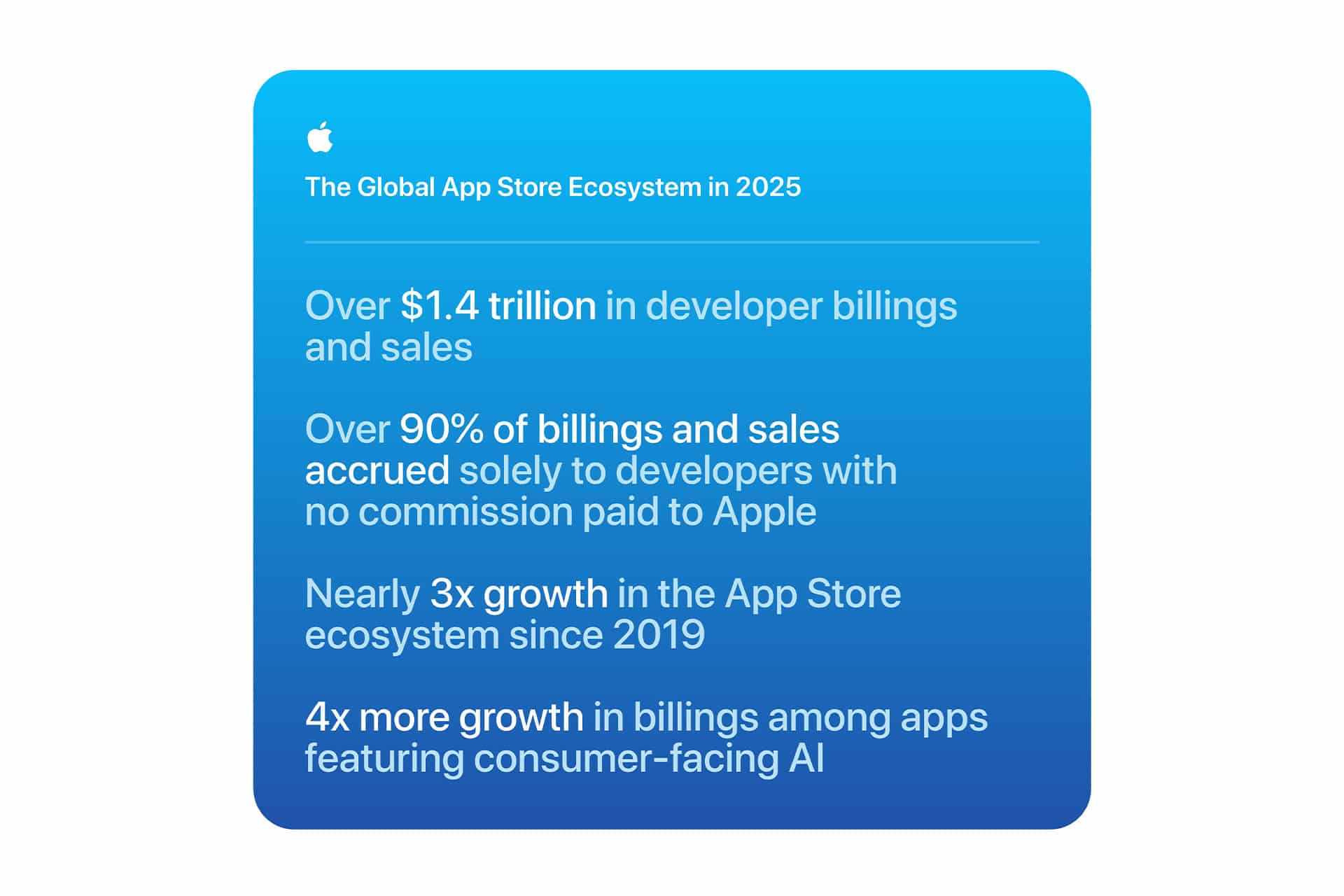
App Store economy growth reached a record $1.4 trillion in developer billings and sales in 2025, according to a new Analysis Group study highlighted by Apple ahead of WWDC26. The figure gives Apple a major services story at a time when developers are preparing for new platform tools, AI frameworks, and software updates across the company’s ecosystem.
Apple said more than 90% of billings and sales facilitated by the App Store ecosystem went entirely to developers, with no commission paid to Apple. That detail matters because the App Store is often discussed through commission disputes, regulatory pressure, and developer policy debates. Apple is using the new study to emphasize the wider economy around apps, including physical goods, services, digital content, subscriptions, and advertising.
The scale is now far beyond app downloads or paid software. The App Store has become a commerce layer for shopping, travel, food delivery, productivity, entertainment, fitness, health, enterprise tools, games, and newer AI-powered experiences. Since 2019, Apple says the ecosystem has nearly tripled, showing how central apps have become to everyday spending and business activity.
App Store Economy Reaches a New Record
The App Store economy reached $1.4 trillion in 2025 across three main categories. Physical goods and services accounted for the largest portion, with $1.1 trillion in sales. That category includes areas such as general retail, grocery, food delivery and pickup, and travel, all of which show how much app-based commerce now extends beyond digital content.
Developer billings and sales from digital goods and services reached $149 billion, driven by games, enterprise apps, and video streaming apps. In-app advertising revenue from ads placed by developers in their apps totaled $151 billion. Together, those categories show how broad the App Store has become as a business platform.
The physical-goods number is especially important because Apple generally does not collect a commission on many of those transactions. A user ordering groceries, booking travel, shopping through a retail app, or arranging food delivery may be using an app downloaded from the App Store, but the transaction usually happens outside Apple’s digital commission structure.
That is why Apple highlights the 90% figure. The company wants to frame the App Store as infrastructure for developer businesses, not only as a marketplace where Apple takes a percentage of paid downloads and in-app purchases. The argument is clear: even when Apple does not receive a commission, the App Store still helps developers reach users and build commercial activity at global scale.
AI Apps Are Growing Faster
Apple also used the report to highlight the rise of AI apps. In 2025, more than 40 of the top 100 apps on the App Store featured consumer-facing AI capabilities, and Apple said those apps saw four times more growth in billings than other top 100 apps.
That gives Apple a useful AI story before WWDC26. The company is still trying to strengthen Apple Intelligence, Siri, and its developer AI tools, but the App Store is already showing that consumer-facing AI has become a major growth driver. Photo and video editing, productivity, health and fitness recommendations, writing tools, education apps, coding tools, and automation apps are all becoming more intelligent as developers add AI features.
Apple is also positioning its own developer tools as part of that shift. The Foundation Models framework lets developers use the on-device large language model at the core of Apple Intelligence to build private, offline intelligent features. Apple says this allows AI inference at no cost to developers while protecting user privacy.
Xcode 26 also plays into the same message. Apple says agentic coding features in Xcode can work with more autonomy toward developer goals, helping creators streamline workflows, iterate faster, and bring ideas to life. That matters because AI is not only changing the apps users download. It is also changing how those apps are built.
For Apple, the opportunity is to make AI feel native to its platforms rather than separate from them. Developers can use Apple’s models, on-device intelligence, privacy protections, and platform APIs to build AI features that fit iPhone, iPad, Mac, Apple Watch, Apple Vision Pro, and future devices.

Global Growth Shows Regional Strength
Apple said the App Store ecosystem has grown strongly across major regions over the last six years. Billings and sales more than doubled in China and more than tripled in the U.S. and Europe. That regional momentum helps Apple show that the App Store is not only a U.S. or Western market story, but a global developer platform.
Physical goods and services accounted for the majority of billings and sales in every region. General retail ranked as the top category across all markets, showing how shopping apps have become a core part of mobile commerce. Beyond retail, regional habits shaped the next strongest categories.
Travel was the second-largest physical goods and services category in the U.S., Europe, Japan, Australia, New Zealand, and Brazil. In Korea, food delivery and pickup ranked second. In China, grocery and food delivery became the second- and third-largest categories.
Those differences are useful because they show the App Store adapting to local markets rather than following one global pattern. An app economy in Brazil may lean heavily on travel and local commerce. Korea may show stronger food delivery behavior. China may reflect grocery and delivery habits. Apple’s platform becomes the common infrastructure, while developers serve local demand.
More Than 850 Million Weekly Users
Apple said the App Store reached more than 850 million average weekly users across 175 countries and regions in 2025. That audience gives developers a distribution channel few platforms can match.
For small developers, the App Store can provide global reach from a single storefront. For large companies, it remains a central way to reach iPhone, iPad, Mac, Apple Watch, Apple TV, and Apple Vision Pro users. For Apple, the figure reinforces why the App Store remains one of the company’s most important services assets.
The App Store’s scale also supports Apple’s broader business. More app activity makes iPhone more valuable. More developer success brings more apps to Apple platforms. More apps keep users engaged inside the ecosystem. More transactions, subscriptions, and services activity strengthen Apple’s role as the platform owner.
That flywheel is one of the reasons the App Store remains so closely watched by regulators and developers. Its size gives Apple enormous influence over distribution, payments, app review, privacy rules, and platform access. The $1.4 trillion figure shows the opportunity, but it also explains why policy debates around the App Store are not going away.
Developer Support Becomes a Bigger WWDC Theme
The timing of Apple’s announcement is important. WWDC26 begins the week after the report, giving Apple a chance to connect the App Store’s economic scale with new developer tools and platform technologies.
Apple said developers and students will have access to more than 100 new video sessions during WWDC26, along with Group Labs and conversations through the Apple Developer Forums. The company also pointed to Meet with Apple sessions, appointments, labs, Pathways, TestFlight, App Analytics, custom product pages, App Store editorial, and developer support in nine languages.
Apple also highlighted its physical developer presence. In 2025, Apple Developer Centers hosted thousands of developers in the U.S., China, India, and Singapore, with a new Apple Developer Center in Berlin opening later this year. Nearly 20 Apple Developer Academies in countries including Brazil, Indonesia, Italy, Saudi Arabia, South Korea, and the U.S. also support training in coding, AI, design, and marketing.
This matters because Apple’s developer pitch is no longer only about building apps for iPhone. The company wants developers to build intelligent experiences across all Apple platforms, use Apple Intelligence where available, support privacy, adopt new frameworks, and create apps that can scale globally through the App Store.
A Strong App Store Story With Policy Pressure
The App Store economy reaching $1.4 trillion gives Apple a powerful number, but it does not remove the policy tension around the marketplace. Developers, regulators, and governments continue to debate Apple’s commissions, app review rules, alternative payment options, sideloading, marketplace access, and the company’s control over iOS distribution.
Apple’s response is to emphasize safety, trust, global reach, developer tools, and economic opportunity. The company wants the App Store to be seen as the safest and best place for users to discover and download apps, while also helping developers build businesses without necessarily paying Apple commission on most facilitated sales.
Both parts can be true at once. The App Store can be a massive economic engine for developers and still be the subject of serious regulatory scrutiny. The $1.4 trillion figure makes Apple’s platform look stronger, but it also makes the platform’s rules more consequential.
For developers, the most important question is practical: can the App Store help them reach users, build revenue, add AI features, and scale internationally? Apple’s report argues yes, especially as AI becomes a larger part of consumer apps and development workflows.
The App Store Enters Its AI Growth Phase
The strongest signal in the report may be the AI growth data. Apps with consumer-facing AI capabilities are already performing better among the top 100 apps, and Apple is preparing to give developers more AI tools through Apple Intelligence, Xcode, and new frameworks.
That sets up the next phase of the App Store economy. The first era was downloads. The second was in-app purchases and subscriptions. The third added large-scale mobile commerce, delivery, travel, and advertising. The next phase may be defined by AI features embedded inside everyday apps.
For Apple, that future depends on developers. Apple Intelligence alone will not make the ecosystem smarter. Developers need to bring intelligence into fitness apps, shopping apps, learning tools, creative editors, productivity software, enterprise workflows, finance apps, travel apps, and games. The App Store gives those developers a global market, while Apple’s tools give them platform-specific ways to build.
The $1.4 trillion milestone gives Apple a strong headline before WWDC26, but the more important story is where the ecosystem is heading. Apps are no longer only software icons on a screen. They are commerce channels, creative tools, business platforms, AI interfaces, and daily services used across nearly every part of modern life.