The first wave of AI systems has already begun replacing cognitive labor, while the second wave — robotics powered by real-world AI — is moving from labs into factories, streets, and logistics networks. This convergence signals a future where productivity no longer depends on human effort in the traditional sense, raising questions not only about jobs, but about relevance, agency, and economic survival.
Humanity is approaching a threshold where work is no longer defined by output alone. In a landscape where AI systems can design, write, calculate, negotiate, and soon physically execute tasks with greater efficiency, the question becomes how humans reposition themselves within that system. Apple’s opportunity lies not in competing with AI on raw capability, but in redefining what productive human participation looks like when intelligence is abundant.
From Labor to Orchestration
Historically, productivity meant doing more work in less time. In an AI-dominated environment, productivity shifts toward orchestration — deciding what should be done, why it matters, and how systems should coordinate to achieve it. Apple devices already operate as control centers rather than simple tools, and this distinction becomes critical in the next phase of work.
An iPhone, iPad, or Mac no longer functions as a single-purpose machine. Combined with automation, analytics, and contextual intelligence, these devices become command interfaces. The human role transitions from executor to strategist, overseeing flows of information, decisions, and outcomes across digital and physical systems.
Apple’s strength is not building the most autonomous AI, but building interfaces that allow humans to remain meaningfully in control of complex systems without being overwhelmed by them.


The Personal Assistant as an Executive Partner
Apple’s vision for a personal assistant evolves naturally in this context. Rather than acting as a reactive helper, the assistant becomes an executive partner — prioritizing information, flagging risks, summarizing performance, and coordinating actions across apps and services.
Email triage, calendar optimization, document synthesis, and communication routing become background processes. The user interacts at a higher level, approving strategies rather than micromanaging tasks. In this model, a single individual can manage what once required an entire administrative team.
The assistant does not replace decision-making. It amplifies it, treating the user as a premium executive whose time and attention are the most valuable resources.


Workflows That Scale Beyond the Individual
Apple’s automation tools already hint at this future. Shortcuts, system-level integrations, and cross-device continuity allow workflows to move seamlessly from idea to execution. In an AI-augmented environment, these workflows expand dramatically.
Sales pipelines can update automatically through Apple Business Connect and integrated CRM systems. Inventory, logistics, and customer engagement data surface on the iPhone as real-time reports rather than static dashboards. Apple Maps provides operational intelligence, tracking fleets, deliveries, or service coverage without requiring dedicated infrastructure.
The result is leverage. A single user can oversee operations that previously required multiple departments, shifting entrepreneurship from capital-intensive structures toward intelligence-driven coordination.
Collaboration Without Friction
Human productivity does not disappear in an AI era; it changes shape. Collaboration becomes less about shared labor and more about shared vision. Apple’s communication tools — FaceTime, Messages, and collaborative apps — enable fast alignment between decision-makers rather than large teams executing repetitive tasks.
Meetings become shorter, more focused, and often asynchronous, supported by AI-generated summaries and action items. Entrepreneurs, investors, and partners interact through Apple devices that maintain continuity across conversations, documents, and decisions.
This environment favors small, agile groups capable of steering large automated systems, rather than massive organizations burdened by internal complexity.


Managing the Physical World Through Digital Control
The second wave of AI — robotics — brings automation into the physical world. Manufacturing, transportation, and logistics increasingly rely on intelligent machines operating autonomously. Apple devices can serve as the human interface layer for these systems.
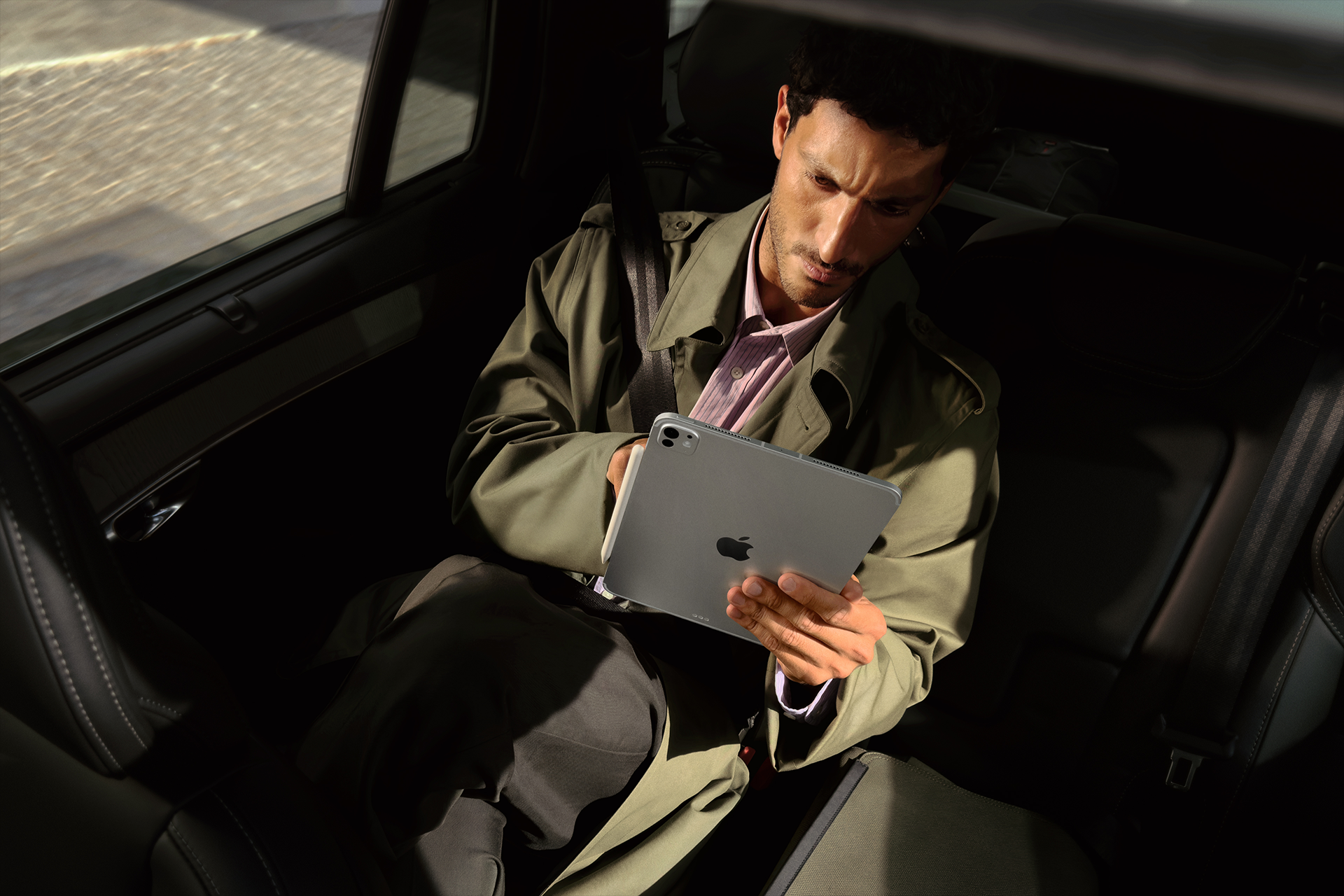
Managing a fleet of autonomous vehicles, for example, becomes an exercise in oversight rather than driving or dispatching. Performance metrics, routing efficiency, maintenance alerts, and financial summaries appear as digestible reports on a phone or tablet. The human role is to intervene when strategy or ethics demand it, not to supervise every movement.
In this sense, Apple’s ecosystem enables individuals to act as operators of complex physical systems without requiring deep technical expertise in robotics or AI.

Entrepreneurship in the Post-Employment Era
As traditional employment models weaken under automation, entrepreneurship becomes less optional and more necessary. Apple’s ecosystem lowers the barrier to entry by integrating identity, payments, marketing, operations, and analytics into a single environment.
An individual can launch, manage, and scale a business from a handful of devices, supported by AI-driven insights rather than large teams. This model does not eliminate competition or risk, but it redistributes opportunity toward those who can think strategically rather than execute manually.
Productivity, in this context, is measured not by hours worked but by systems effectively managed.
Preserving Human Agency
The greatest risk of an AI-dominated world is not unemployment, but loss of agency. When systems become too opaque or autonomous, humans risk becoming spectators rather than participants. Apple’s design philosophy offers a counterbalance by emphasizing clarity, privacy, and user control.
Interfaces matter. Transparency matters. Trust matters. Apple’s focus on on-device processing, privacy boundaries, and intuitive design positions it as a mediator between overwhelming intelligence and human comprehension.
Rather than pushing users to adapt to machines, Apple adapts machines to human cognition.
A Cooperative Future, Not a Competitive One
The narrative of AI as an adversary misses a crucial possibility: cooperation. When intelligence is abundant, the limiting factor becomes judgment, ethics, creativity, and direction. Apple’s ecosystem is uniquely suited to support this cooperative model, where humans define goals and values while AI systems execute at scale.
In this future, productivity is no longer about surviving automation, but about using it to expand what a single human can responsibly manage. Apple’s role is not to build the machines that replace people, but to build the tools that ensure people remain central to the system.
The post-human era does not have to mean post-human relevance. With the right interfaces, ecosystems, and values, it can mean the opposite: a world where individual human vision scales farther than ever before.