

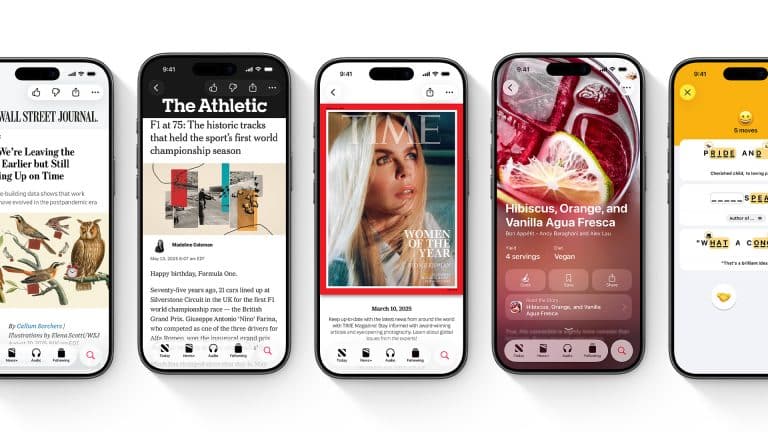
Apple News can give students something increasingly difficult to find online: a structured starting point for understanding what is happening before social media reactions, misleading clips and algorithmic speculation take control of the story.
The app combines selections made by human editors with personalized recommendations based on reading interests. That balance does not make every article neutral or automatically accurate, but it creates a more useful environment for learning how professional news coverage works.
For students, the educational value comes from more than reading headlines. Apple News can place several publishers around the same event, making differences in language, evidence, emphasis and editorial perspective easier to identify. A political announcement may be covered as a policy story by one publication, an economic story by another and a cultural conflict by a third.
Comparing those approaches can help students understand that media literacy is not simply deciding whether an article is true or false. It also involves asking who produced it, which evidence supports it, what context may be missing and how presentation influences interpretation.


Apple News Creates a Better Starting Point
Apple News editors organize major stories, breaking developments and subject collections across publications with different audiences and editorial traditions.
That structure offers an alternative to discovering news through a single viral post. Social platforms often present information after it has been shortened, reframed or detached from its original source. A student may encounter a screenshot of a headline without the article, a video segment without its preceding question or a statistic without the study behind it.
Opening a full report inside Apple News restores some of that missing context. The publication name is visible, the writer is identified and the article can usually be examined alongside other coverage of the same subject.
Apple News Today also provides a weekday audio briefing that can introduce major developments before students explore them in greater detail. Audio summaries are useful for orientation, but they can also become an exercise in recognizing selection. Students can consider why certain stories were included, how much time each received and what additional questions remain unanswered.
The Today feed can similarly demonstrate the difference between editorial selection and personalized recommendation. Human editors identify stories they consider broadly significant, while algorithms suggest material based partly on individual interests and activity.
Understanding that distinction is central to media literacy. Every news environment makes decisions about visibility. A newspaper chooses its front page, a television network builds a running order and a social platform ranks posts through software. Apple News allows students to observe more than one of those systems inside the same app.
Also, make sure to subscribe to our official AppleMagazine channel on Apple News.
Curation Reduces Noise but Does Not Remove Bias
A curated news platform should not be mistaken for a perfectly objective one.
Apple editors decide which publications, topics and stories receive prominent placement. Publishers make their own decisions about headlines, sources, images and framing. Individual reporters work within editorial standards but may approach an issue through different evidence or priorities.
Those variations are not necessarily failures. They can show students why reading more than one reputable source is valuable.
A useful comparison begins with two or three reports about the same event. Students can identify which facts appear consistently, which claims are attributed to named sources and which interpretations belong to analysts, officials or the writer.
Headline differences are particularly revealing. One publisher may emphasize economic consequences, another may focus on political conflict and a third may lead with the people directly affected. None of those choices alone provides the complete picture.
The exercise becomes more valuable when opinion pieces are included. Apple News contains reporting, commentary, reviews, analysis and editorials. Learning to distinguish among those formats prevents students from treating every published article as the same type of evidence.
Opinion writing can be informed and useful, but it has a different purpose from a reported news article. Analysis may explain likely consequences without claiming certainty. A feature can use narrative detail that would not appear in a breaking-news update.
Students who recognize those categories are better equipped to judge what an article can reasonably prove.
Apple News also allows users to follow particular topics and publications. That convenience can create another teaching opportunity: a highly personalized feed may gradually narrow the range of perspectives a student encounters.
Following familiar sources is useful, but media literacy requires occasional exposure to reporting that challenges existing assumptions. Students can intentionally add publications with different specialties, geographic coverage or editorial viewpoints while maintaining standards for evidence and transparency.

Source Comparison Builds Stronger Research Habits
The habits developed through news comparison can extend into school research.
Students frequently begin assignments with a search engine and select one of the first results. That method rewards ranking rather than credibility. A polished page, professional logo or confident tone can make weak information appear authoritative.
Apple News does not eliminate the need to evaluate a source, but it can familiarize students with established publishers and common journalistic practices. Articles often include direct quotations, links to documents, references to public records and explanations of how information was obtained.
Students can look for those signals rather than relying on appearance.
The News Literacy Project encourages readers to examine evidence, sources, context, reasoning and authenticity when evaluating a claim. Those factors can be applied directly while reading Apple News.
Evidence asks whether the article provides material supporting its central claims. Sources reveal who supplied the information and whether they possess relevant knowledge. Context determines whether a quotation, image or statistic has been presented accurately. Reasoning tests whether the conclusion follows from the available evidence. Authenticity helps identify manipulated media, impersonation and fabricated documents.
Another valuable technique is lateral reading. Instead of remaining on one article and judging it entirely from its design, students open other sources to investigate the publisher, writer and claim.
A report about a scientific study, for example, can be compared with the university announcement, research paper or comments from independent specialists. A political claim can be checked against legislation, transcripts, government data or coverage from reporters at the event.
Apple News provides the initial report, but the verification process may continue in Safari or dedicated research databases.
Curated News Works Best With Active Readers
Apple has previously supported media literacy organizations including the News Literacy Project and Common Sense, recognizing that access to information alone does not create informed readers.
The essential skill is active reading.
Students can pause before sharing an alarming headline, identify whether the article contains original reporting and check whether other credible outlets have confirmed the claim. They can separate evidence presented by the reporter from quotations made by interested parties.
Images deserve the same attention. A genuine photograph may be old, cropped or associated with the wrong event. AI-generated pictures and synthetic audio add another layer of difficulty because visual quality is no longer reliable evidence of authenticity.
Apple News offers a more controlled environment than an unrestricted social feed, but misleading claims can still appear in quotations, opinion writing or developing stories that later require correction. Professional journalism reduces risk through editing and verification; it does not remove the possibility of error.
That limitation makes corrections and updates educationally useful. When a publication revises a report, students can examine what changed and why. Transparent corrections demonstrate that credibility depends partly on acknowledging mistakes rather than pretending they never occurred.
A classroom using Apple News does not need to treat the app as a textbook. It works better as a live collection of material for comparison: three headlines about one event, two explanations of the same economic data or competing analyses of a new technology policy.
Students can then move beyond asking which article they agree with. The stronger questions concern which report offers the best evidence, which distinction is supported by the available facts and what additional information would be needed before reaching a conclusion.
That shift—from reacting to evaluating—is where curated news becomes a genuine media literacy tool.