

Apple has quietly confirmed one of its most consequential technology partnerships in years. After months of speculation, the company acknowledged that future versions of Siri and Apple Intelligence will be built on Google’s Gemini models, under a multi-year collaboration between the two companies.
The move does not replace Apple’s own work on artificial intelligence. Instead, it reshapes the foundation beneath it, blending Apple’s on-device intelligence and privacy architecture with Google’s large-scale AI models and cloud technology.

A Strategic Shift, Not a Surrender
In a statement shared publicly, Apple said it selected Google’s technology after “careful evaluation,” describing Gemini as the most capable foundation for its Apple Foundation Models. The emphasis was clear: this is about infrastructure, not identity.
Apple Intelligence will continue to run across Apple devices and Apple’s Private Cloud Compute, preserving the company’s privacy model. Google’s role is to provide the underlying model strength that enables more advanced reasoning, language understanding, and contextual awareness.
Rather than competing head-on in building massive cloud-scale models from scratch, Apple is choosing to integrate best-in-class technology where it makes sense, while retaining control over user experience, privacy, and system integration.
What This Means for Siri
The most visible impact of the Gemini partnership will be felt through Siri. At WWDC 2024, Apple introduced a next-generation Siri designed around personal context, in-app actions, and on-screen awareness. While many Apple Intelligence features shipped on schedule, this revamped Siri was delayed.
The Gemini confirmation helps explain why.
Powering a more conversational, context-aware assistant requires models that can reason across language, intent, and data at scale. According to reporting cited by Apple, Gemini models will support select Apple Intelligence features, including this new version of Siri, which is now expected to arrive later this year.
Apple has not detailed exactly which Siri capabilities will rely on Gemini and which will remain fully powered by Apple’s own models, but the hybrid approach appears intentional.

Inside the Deal
While neither company has disclosed financial or technical specifics, reporting indicates that Apple will pay Google roughly $1 billion per year for access to Gemini models. Bloomberg has also reported that Apple plans to use a 1.2-trillion-parameter AI model for the next iteration of Siri, underscoring the scale involved.
Apple and Google have both stressed that this is a collaboration, not a dependency. Apple’s models will continue to power many Apple Intelligence features, with Gemini supporting others where larger model capacity is required.
This layered strategy allows Apple to move faster in AI without compromising its long-standing principles around user trust.
Apple Intelligence, Reframed
Apple Intelligence was never positioned as a single model or chatbot. From the start, Apple described it as a system that blends on-device processing, private cloud computation, and selective use of external models.
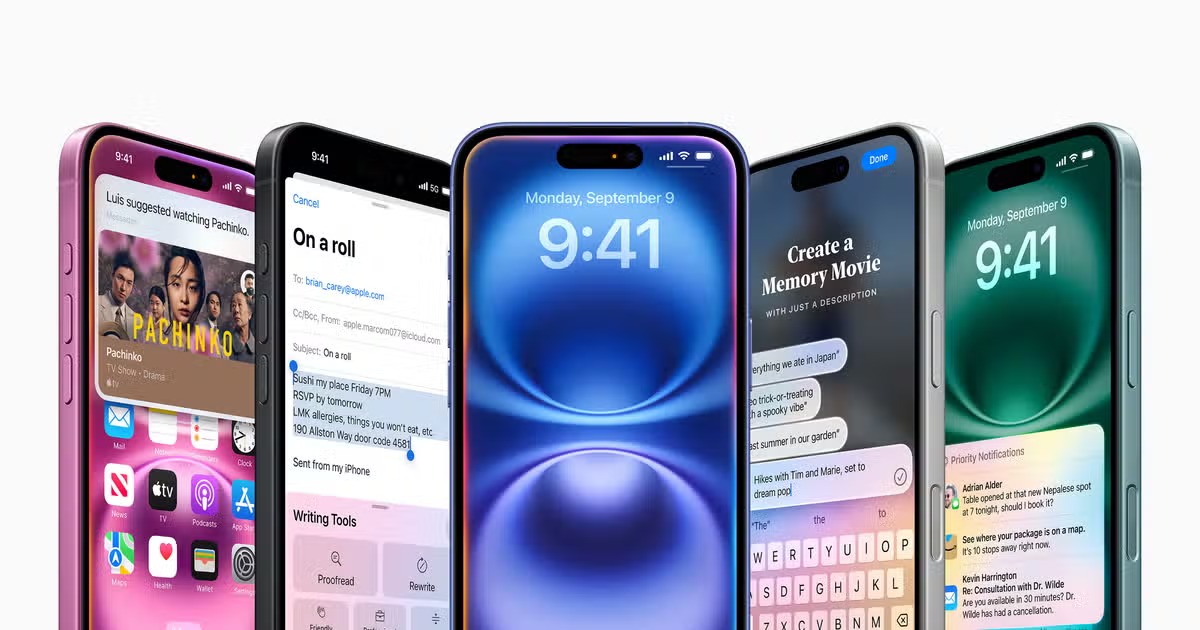
The Gemini partnership fits squarely into that vision. Notification Summaries, Writing Tools, Image Playground, Genmoji, and other features already operate across different layers of intelligence. Adding Gemini strengthens the top layer, where deeper reasoning and language understanding are most demanding.
Importantly, Apple has reiterated that privacy standards remain unchanged. Data handling, user control, and transparency remain central, regardless of which model contributes to a given feature.
A Rare Apple Move, With Familiar Logic
Apple rarely confirms partnerships of this magnitude so directly. That alone signals how central AI has become to the platform’s future. Yet the logic behind the decision mirrors past Apple strategies: adopt the strongest underlying technology available, then wrap it in Apple’s own design, controls, and values.
Siri’s next chapter will not be defined by a single company’s AI vision, but by how seamlessly that intelligence fits into daily use across Apple devices.


