Apple vs Adobe reflects a deeper philosophical split than most people realize. Adobe built an empire by making software that could run on anything, anywhere. Apple is now building something very different, where creative work is designed to live inside a single, tightly integrated environment that stretches across hardware, software, cloud, and artificial intelligence.
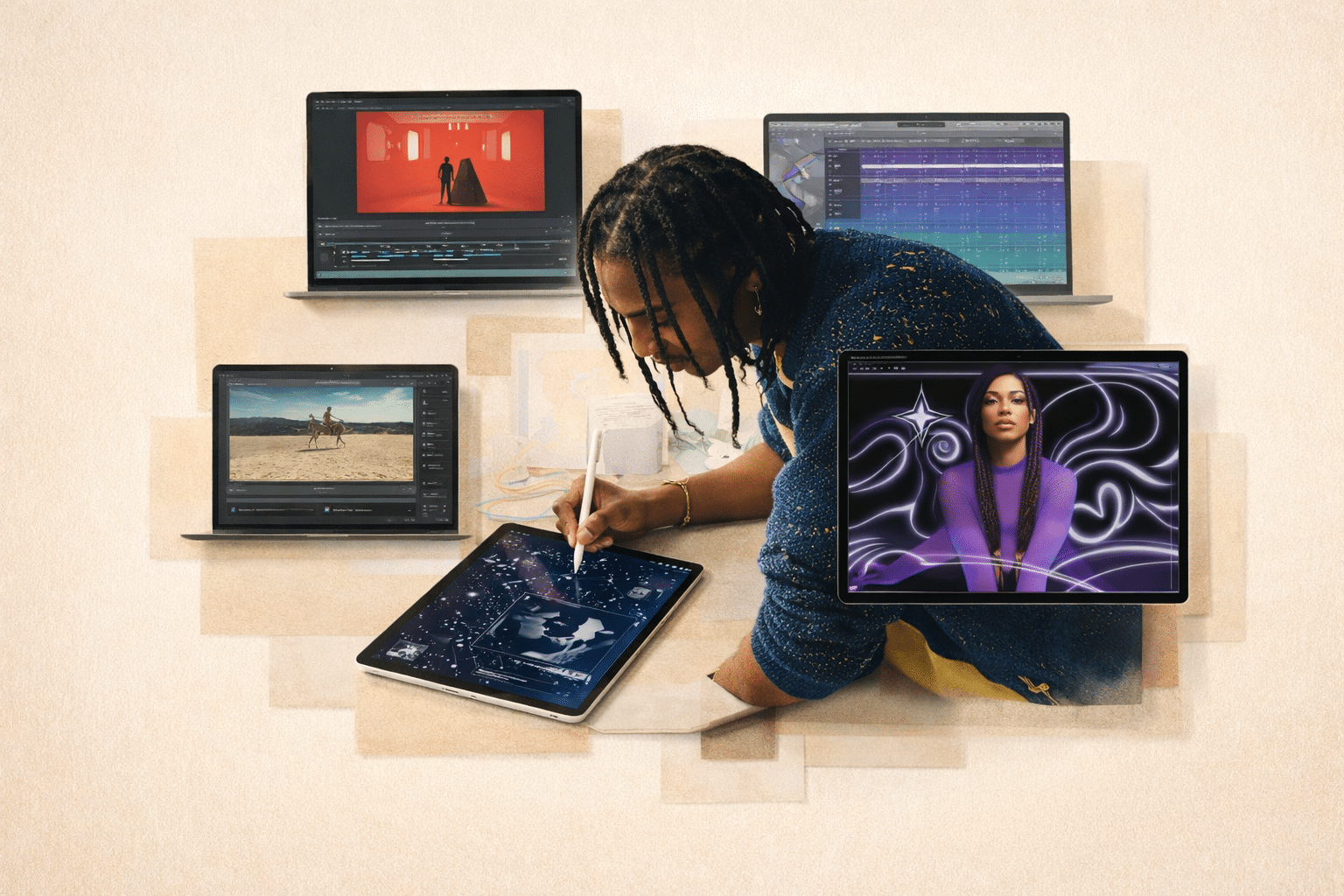
Apple Creator Studio brings together Final Cut Pro, Logic Pro, Pixelmator Pro, Motion, Compressor, MainStage, and premium intelligence inside Keynote, Pages, Numbers, and Freeform.
Adobe Creative Cloud gathers Photoshop, Premiere Pro, After Effects, Illustrator, Audition, and dozens of other tools into a massive, flexible toolbox that in the most part is just a waste of memory.
Both aim to serve creators, but the way they do it could not be more different.
Adobe’s approach grew out of the desktop publishing era. It assumes that professionals will invest years learning extremely complex interfaces, confusing icons, and workflows in exchange for total control. Apple Creator Studio, by contrast, is built around a simpler surface that hides powerful tools behind context, touch, voice, and AI assistance. Apple is not trying to replicate Adobe’s complexity. It is trying to replace it with intelligence.
Apple’s System-Level Creative Model
Apple vs Adobe becomes clearer when you look at where the software lives. Apple Creator Studio runs inside macOS, iPadOS, and iOS, drawing power directly from Apple silicon, Apple Intelligence, and iCloud. Projects do not just sit in folders. They are indexed, searchable, and enhanced by on-device and cloud-based AI.
A video edited in Final Cut Pro benefits from transcript search, object recognition, and beat detection because those tools live inside the operating system. A song mixed in Logic Pro uses AI Session Players and chord recognition that are integrated into Apple’s audio framework. Images edited in Pixelmator Pro use Super Resolution and Auto Crop driven by Apple’s machine learning models.
The creative process becomes part of the system itself.

Pricing and Long-Term Cost
Apple vs Adobe also plays out in how creators pay. Adobe Creative Cloud has become one of the most expensive subscriptions in the software industry. Over a decade, a full Creative Cloud plan can cost several thousand dollars. Apple Creator Studio costs far less per month and includes professional tools that were once sold individually at premium prices.
Apple is not trying to squeeze every dollar out of software. It is using software to make the hardware and ecosystem more valuable. A creator who relies on Apple Creator Studio is more likely to keep a Mac, an iPad, iCloud storage, and Apple services. That lifetime value matters more than subscription margin.
Adobe has no hardware flywheel. Its business depends on software revenue alone, which creates pressure to keep raising prices.
Performance and Reliability
Apple vs Adobe also diverges in how performance is delivered. Apple builds the chips, the operating systems, and the apps. That allows Final Cut Pro, Logic Pro, and Pixelmator Pro to run with extremely low latency, high efficiency, and deep access to GPU and neural engines.
Adobe has to support countless configurations across Windows and macOS. That flexibility comes at the cost of performance tuning and stability. Apple’s tools can be optimized for a small number of machines in a way Adobe’s cannot.
For video, audio, and image work, that difference shows up as faster renders, smoother timelines, and better battery life on Apple laptops and tablets.

Privacy and Creative Data
Apple vs Adobe also reflects two approaches to data. Apple positions privacy as a system-level principle. Apple Creator Studio uses on-device models and private cloud compute for many AI features, reducing how much personal creative data leaves the device.
Adobe’s cloud-first model requires uploading assets to its servers for AI processing, collaboration, and storage. That is convenient, but it also means creative libraries and project history live on Adobe’s infrastructure.
For professionals working with sensitive material, that difference matters.
The New Generation of Creators
Apple Creator Studio is not designed to replace Adobe overnight. It is designed to win over the next generation. Younger creators grow up with touch screens, voice assistants, and AI tools. They expect software to help them, not challenge them.
Adobe’s complex panels, menus, and workflows remain powerful, but they demand long training. Apple’s tools offer depth through discovery, context, and intelligent assistance. The learning curve is softer, but the ceiling is still high.
Apple vs Adobe is ultimately about who controls the future of creative work. Adobe owns the past. Apple is building something that looks forward.