

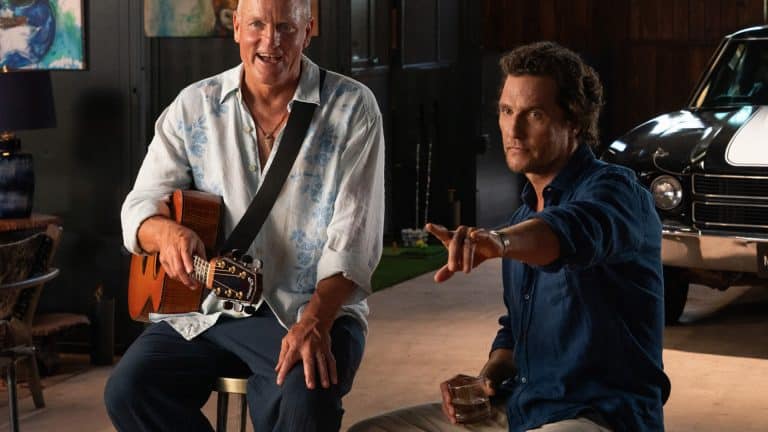
Apple TV has set a September 23 global premiere for Brothers, a new eight-episode comedy series starring Matthew McConaughey and Woody Harrelson as fictionalized versions of themselves. The series will debut with its first two episodes, followed by one new episode every Wednesday through November 4, giving Apple a fall comedy launch built around two actors whose real-life friendship already carries its own mythology.
The premise leans directly into that public fascination. In Brothers, McConaughey and Harrelson play versions of themselves whose longtime bond is shaken when they discover a decades-old secret: they might actually be brothers. The story begins after Woody’s daughter’s wedding falls apart, sending him and his relatives to Austin for an extended stay at Matthew’s ranch. What starts as a recovery trip soon turns into a search for answers after Matthew’s mother, Ma Mac, played by Holland Taylor, lets slip that the two men’s connection may be more than friendship.
Apple’s announcement positions Brothers as a comedy about fame, identity, friendship, and the blurry space between celebrity stories and private lives. It also gives Apple TV a high-profile vehicle for two actors who have rarely needed much introduction, especially to audiences familiar with their shared history on-screen and off.


A Comedy Built Around a Real-Life Friendship
The casting is the hook, but the series is not just relying on name recognition. Brothers is designed around the unusual public dynamic between McConaughey and Harrelson, whose friendship has long been part of their appeal. The show turns that familiarity into the engine of the story, using the rumor that they could be related as a springboard for a fictional comedy.
That approach gives Apple TV a series with a built-in conversation starter. McConaughey and Harrelson are not playing unrelated characters hidden behind a traditional sitcom setup. They are playing heightened versions of themselves, which lets the show blur performance, biography, Hollywood gossip, and Texas-flavored absurdity without needing to explain why audiences should care about the relationship.
The Austin ranch setting also gives the series a specific texture. McConaughey’s public identity is closely tied to Texas, while Harrelson’s character arrives as the disruptor, turning a retreat into a chaotic investigation. Apple’s description also adds another thread: Matthew is dealing with an identity crisis tied to a potential run for governor of Texas. That political subplot gives Brothers room to play with celebrity ambition, public image, and the strange logic of fame.
The setup sounds broader than a buddy comedy, but the strongest selling point is still the chemistry between its leads. Apple TV has increasingly used recognizable stars to anchor original series, but Brothers has an advantage because the central relationship already exists in the public imagination. The series can spend less time establishing the bond and more time testing it.
Apple TV Adds Another Star-Driven Comedy
Brothers comes from Paramount Television Studios and is showrun and executive produced by Lee Eisenberg, whose recent work includes Jury Duty and Lessons in Chemistry. Eisenberg’s presence gives the series a useful creative bridge between character-driven comedy and a premise that could easily become too self-referential without careful handling.
McConaughey and Harrelson also executive produce, alongside Natalie Sandy, David West Read, Trish Hofmann, Bill Bost, Jason Winer, David Finkel, Brett Baer, and Jeremy Plager. Trent O’Donnell directs multiple episodes, including the pilot. The ensemble cast includes Natalie Martinez, Brittany Ishibashi, Nolan Almeida, Ella Grace Helton, Noah Carganilla, Highdee Kuan, Oona Yaffe, and Holland Taylor.
For Apple TV, Brothers fits a growing comedy slate that has become one of the service’s most durable categories. Ted Lasso gave Apple TV its first major comedy breakout, while The Studio expanded the service’s interest in Hollywood satire and industry-driven humor. Brothers sits in a different lane, combining celebrity fiction with a buddy-comedy structure and a family-secret premise.
The release pattern also follows Apple’s familiar weekly rhythm. By launching with two episodes, Apple gives viewers enough material to understand the tone before settling into a weekly schedule. The September 23 debut places the show in the early fall window, with the finale landing November 4, keeping it active across several weeks of entertainment coverage.

Why Brothers Fits Apple’s Fall Lineup
Apple TV has become more aggressive with star-led programming, especially projects that can cut through a crowded streaming calendar. Brothers has the kind of logline that works quickly: McConaughey and Harrelson play themselves, and they might be actual brothers. That sentence alone gives the show a marketing advantage over quieter comedies that require more explanation.
It also arrives at a time when Apple is trying to give its service more frequent appointment viewing. Weekly episodes help keep a series visible beyond its launch day, especially when the premise invites viewers to debate how much of the story is fictionalized and how much is winking at reality. Brothers seems built for that kind of conversation.
There is also a practical reason the series may help Apple TV. Comedies are often easier to sample than dense dramas, and recognizable leads reduce the barrier for casual viewers. McConaughey and Harrelson bring different fan bases, from True Detective viewers to film audiences who know them through decades of major roles. Pairing them in a self-aware comedy gives Apple a show that can appeal to viewers who may not follow every Apple Original release.
Apple TV’s service pitch remains tied to premium originals, commercial-free viewing, and availability across Apple devices, smart TVs, streaming sticks, game consoles, and web browsers. Brothers gives that pitch another mainstream title, not because it expands the service into a new genre, but because it uses celebrity familiarity in a way that feels unusually direct.
The most interesting test will be tone. A show about actors playing themselves can feel too pleased with its own premise if the writing does not give the supporting cast and story enough room. Holland Taylor’s Ma Mac may be central to solving that problem, since her accidental reveal appears to set the whole series in motion. If Brothers gives her more to do than deliver the secret, Apple may have a comedy that works beyond the novelty of its two headline names.