

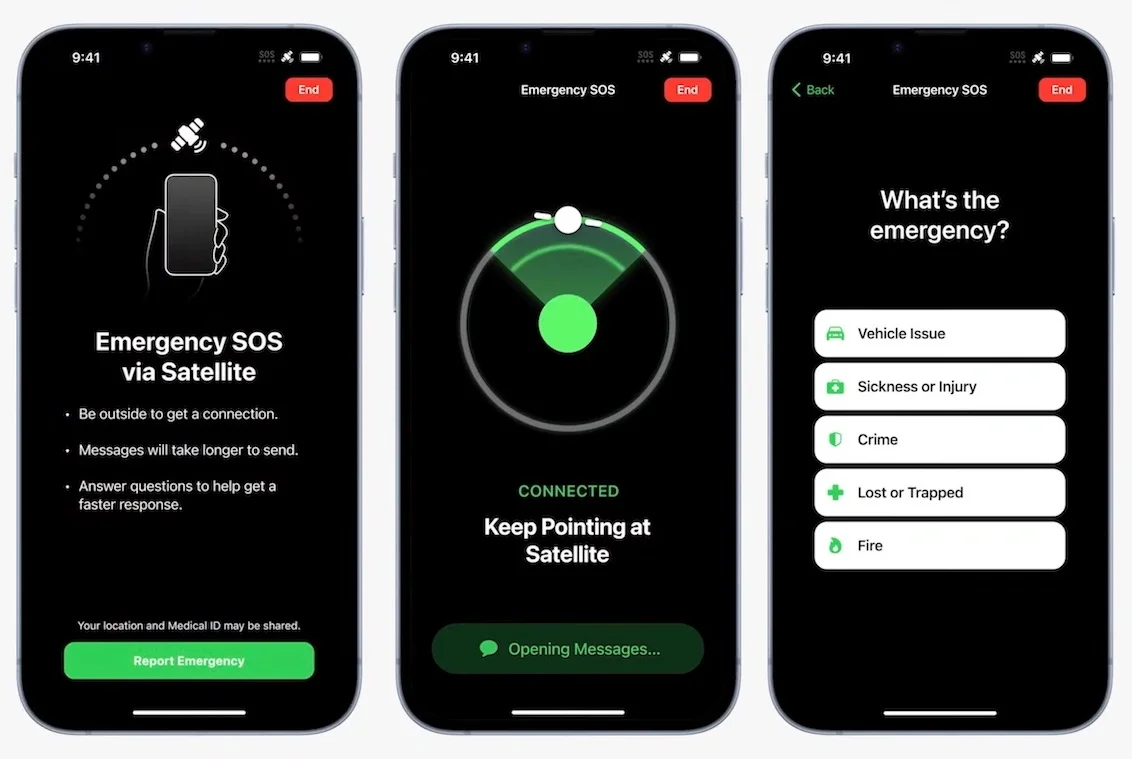
Direct satellite has become one of the most important long-range questions around the iPhone. Apple already brought satellite connectivity into daily awareness by turning it into something practical: emergency texting, roadside assistance, off-grid messaging, and location sharing when cellular and Wi-Fi are unavailable. On current iPhone models, those features are real, useful, and increasingly familiar. Apple’s own support pages say iPhone 14 or later can use satellite connection for Emergency SOS, Messages via satellite, Roadside Assistance via satellite, and Find My sharing when there is no cellular or Wi-Fi coverage.
The bigger question is what comes next. Many people now imagine a future where an iPhone could connect to satellites in a way that feels much closer to ordinary internet access, almost like satellite Wi-Fi in your pocket. That future is still not here. Apple has not announced full direct satellite data access for iPhone, and nothing in its official product pages suggests that current iPhones can browse the web, stream media, or use satellite as a normal replacement for mobile broadband. What Apple has built so far is narrower and more carefully defined. It is designed around critical communication when the usual networks disappear.
What makes this moment more interesting is the new Amazon move. Amazon announced yesterday that it plans to acquire Globalstar for $11.57 billion, and said Amazon and Apple also signed an agreement to provide satellite connectivity for current and future iPhone and Apple Watch features. Reuters separately reported that Amazon wants to use Globalstar’s assets and direct-to-device capabilities to challenge Starlink, with Amazon targeting direct-to-device service deployment beginning in 2028.

Apple’s Current Satellite Features Are Still Built Around Utility
Right now, Apple’s satellite story is grounded in restraint. The company has not presented satellite as a new everyday internet pipe. It has presented it as a safety and continuity layer. On official support pages, Apple frames the technology around the moments when a person is off the grid and cannot rely on cellular or Wi-Fi. That framing matters because it explains both the current value and the current limits. Satellite on iPhone is already meaningful, but it is meaningful in a focused way.
That focused approach also fits Apple’s style. The company rarely launches an emerging technology by handing users a rough, open-ended system and asking them to manage the complexity. Instead, it tends to narrow the first use cases until the experience feels stable. Emergency SOS via satellite is a perfect example. The feature is not trying to be everything. It is trying to work in the exact moment it matters most. Messages via satellite follows the same logic. It extends communication in a constrained environment, not as an always-on substitute for terrestrial networks.
That means the current generation of satellite features should be understood as a first chapter, not the final form. The iPhone already has the behavioral foundation: point the phone, connect to a satellite, exchange essential information, stay reachable. The distance between that and full satellite data is still very large, but it is no longer abstract.
Amazon, Globalstar, and the Next Competitive Phase
The Amazon-Globalstar deal changes the conversation because it adds scale and urgency. Reuters reported that Amazon’s acquisition is designed to strengthen its satellite connectivity business against Starlink and to position Amazon to start direct-to-device services by 2028. Amazon’s own announcement goes further for Apple users, because it explicitly says Amazon and Apple signed an agreement covering current and future iPhone and Apple Watch features. That does not mean Apple has promised satellite internet on iPhone. It does mean Apple now has a public path tied to a much larger satellite ambition than the one people associated with Globalstar alone.
That matters for two reasons. First, scale is essential if satellite connectivity is ever going to feel broad enough for more normal data usage. Second, competition is increasing quickly. Starlink is developing direct-to-cell services with carrier partners, Amazon wants to build its own direct-to-device future through Globalstar and its larger Leo constellation, and Apple sits in the middle as a hardware platform that already proved people will use satellite features if they are integrated well.
There is also a practical point here. Apple does not need to become a satellite operator to benefit. Its strength is in controlling the device, the chip, the software, and the user experience. If Amazon builds the broader orbital infrastructure and Apple shapes how that connectivity is exposed to the user, the partnership becomes strategically powerful without forcing Apple to build a full space business itself. That has been Apple’s pattern in other areas too: own the experience, partner where infrastructure is expensive.

When iPhone Could Get Something Closer to Satellite Data
This is where the answer needs to stay honest. There is no official Apple date for full satellite data access that works “just like Wi-Fi.” Apple has announced satellite messaging and safety features. Amazon has publicly targeted 2028 for direct-to-device deployment after the Globalstar acquisition. That gives the market a visible time horizon for broader satellite capability, but it still does not equal an Apple promise that iPhone users will have full internet-style satellite access by then.
Even if the technology reaches that point, the experience may not arrive all at once. It is more realistic to expect expansion in layers. First come safety services. Then limited personal messaging. Then perhaps broader communication functions, more persistent low-bandwidth connectivity, or selective app-level features. A full “like Wi-Fi” experience would require enough capacity, low enough latency, affordable enough pricing, and consistent enough coverage to feel normal. That is a much higher bar than emergency text exchange.
Still, the direction is becoming easier to see. Apple has already made satellite useful. Amazon’s Globalstar acquisition makes the network side more ambitious. Starlink has already pushed the market to think bigger. The real shift is that satellite is no longer just a rescue feature in theory. It is becoming a competitive layer in personal connectivity, and the iPhone is already part of that transition. The next few years will decide how far Apple wants to let that layer grow beyond messages and safety into something closer to everyday data.


