

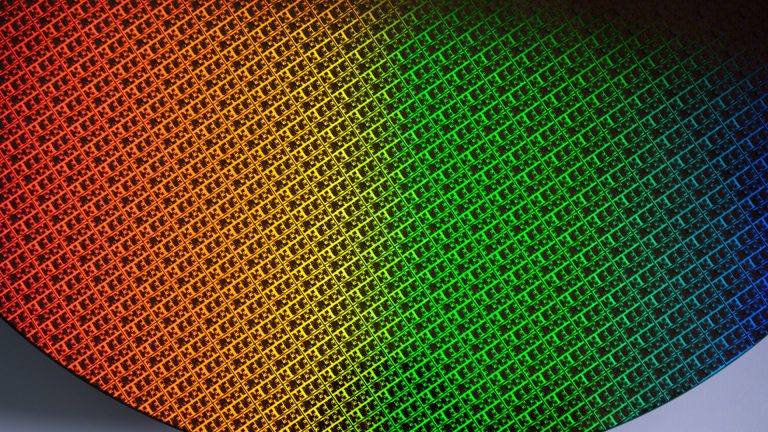
Intel has moved its most advanced chip process, 18A-P, into risk production, giving the company a badly needed foundry milestone and giving Apple a more credible alternative as it explores future chip manufacturing beyond TSMC.
The step does not mean Intel is already mass-producing Apple chips. It does not mean Apple has abandoned TSMC. It also does not mean Intel has solved every yield, packaging, and volume challenge standing between a test run and a product shipping inside a Mac or iPad. But it does show that Intel’s most relevant advanced-node pitch is no longer only a roadmap slide.
Intel says 18A-P, the first performance-enhanced version of its 18A process family, has entered risk production on the schedule shared with customers and partners last year. The company says the node can deliver up to 9 percent better performance at the same power, or up to 18 percent lower power at the same performance, compared with the base 18A process.
For Apple, those numbers matter because battery life, heat, sustained performance, and manufacturing reliability sit at the center of every M-series chip decision. Apple’s chip designs are its own, but the manufacturing partner determines how efficiently those designs can be produced at scale.
Intel Gets a Foundry Proof Point
Intel has spent years trying to rebuild confidence in its manufacturing roadmap. The company’s foundry ambitions depend on convincing outside customers that it can deliver advanced chips with the consistency, yields, capacity, and cost discipline required by companies that ship in huge volumes.
18A is already central to that pitch. It brings RibbonFET, Intel’s gate-all-around transistor design, and PowerVia, Intel’s backside power delivery technology. Those changes are meant to improve performance, efficiency, and density while pushing Intel back into direct competition with TSMC and Samsung at the leading edge.
18A-P is the more refined version. Intel says it keeps design-rule compatibility with x`, making it easier for customers to move designs across the family, while improving power, performance, variability, and thermal behavior. That compatibility matters for foundry customers because every node transition adds engineering cost and risk.
Risk production is not the same as full-scale manufacturing. It is an early production phase where the process is mature enough for real customer engagement, validation, test chips, and preparation for later volume ramps. Still, for Intel Foundry, the milestone gives customers something more concrete to evaluate.

Apple Needs More Than One Manufacturing Answer
Apple’s relationship with TSMC remains one of the most valuable partnerships in technology. TSMC manufactures the A-series chips for iPhone and the M-series chips for Mac and iPad, giving Apple access to world-leading process technology and packaging capabilities. Apple has benefited from being one of TSMC’s closest and most demanding customers.
That dependence also creates exposure. Apple ships devices at enormous scale. A supply disruption, geopolitical shock, capacity constraint, or pricing pressure around one foundry partner can affect major product lines. Diversifying even a small part of chip production would give Apple more leverage and more resilience.
That is where Intel becomes interesting again. A possible Apple-Intel manufacturing deal would not bring back Intel-designed Mac processors. Apple would still design its own chips. Intel would be acting as a foundry, building Apple-designed silicon.
That distinction is essential. The Intel Mac era ended because Apple wanted better performance per watt, tighter control, and a custom silicon roadmap. A future Intel foundry deal would be a supply-chain arrangement, not a reversal of Apple Silicon.
The Likely Target Is Not iPhone First
If Apple uses Intel 18A-P, the most realistic starting point would not be the highest-volume or most demanding iPhone chip. Reports and market chatter have pointed more often to entry-level M-series chips for Mac and iPad.
That would make sense. Apple could test Intel’s process on lower-risk chip families while keeping its most critical iPhone silicon and top-end Pro chips at TSMC. A MacBook Air, entry iPad Pro, or other M-series product would still be a major win for Intel, but it would give Apple a safer way to evaluate yields, cost, power behavior, and delivery schedules.
Apple is careful with supplier transitions. The company rarely moves its most sensitive production all at once. It tests, qualifies, ramps, and keeps backup options. A limited M-series agreement would fit that pattern.
For Intel, even a smaller Apple order would be a powerful endorsement. Apple is known for tough supplier standards. If Intel can satisfy Apple, other customers would notice.
TSMC Still Has the Lead
Intel’s 18A-P progress should not be mistaken for a TSMC defeat. TSMC still has the strongest advanced-node manufacturing record in Apple’s current supply chain, and its packaging technologies remain critical for high-performance chips.
Manufacturing a modern Apple chip is not only about the front-end process node. Packaging, yield learning, defect density, thermal management, test infrastructure, design tools, capacity planning, and production discipline all matter. TSMC has built years of trust with Apple across those areas.
That is why a possible Intel deal would likely be additive rather than replacing TSMC. Apple can use Intel as a second source, a U.S. manufacturing option, or a future bargaining chip without weakening its core relationship with TSMC.
The political angle is also hard to ignore. U.S.-based advanced chip production has become a national priority, and Apple has faced steady pressure to increase domestic manufacturing ties. Intel gives Apple a way to support U.S. semiconductor production without redesigning its product strategy around Intel CPUs.
Why 18A-P Matters for Apple Silicon
Apple Silicon is built around performance per watt. The best Apple chips are not only fast; they are efficient enough to deliver quiet laptops, thin tablets, long battery life, and strong sustained performance without the thermal behavior that defined many Intel Mac years.
Any foundry hoping to build Apple chips has to meet that standard. Intel’s 18A-P claims of higher performance or lower power address that exact requirement. The node’s improved thermal behavior and design compatibility also make it more attractive for chips that need predictable performance inside compact devices.
The challenge is proof at scale. Apple does not buy promise. It buys repeatable output. Intel has to show strong yields, stable delivery, competitive pricing, and enough capacity for Apple’s rhythm of annual upgrades.
That is the difference between a promising node and a product partnership.
Intel’s Foundry Business Needs a Signature Customer
Intel Foundry needs external customers to prove its business model. Building chips for Intel’s own CPUs is not enough. The foundry business needs companies that trust Intel with designs in markets where TSMC has been dominant.
Apple would be the name Intel wants most. Even a partial Apple order would change the way the market views Intel Foundry. It would show that a company with Apple’s scale and engineering standards sees Intel as viable for at least some future silicon.
That could help Intel attract other customers in AI, cloud, automotive, PCs, and consumer electronics. The foundry business is as much about confidence as technology. Customers want to know that a process will be ready, mature, and supported for years.
18A-P entering risk production gives Intel a stronger sales conversation. Apple deciding to use it would give that conversation much more weight.
Apple’s Return to Intel Would Look Very Different
The irony is obvious. Apple spent years moving the Mac away from Intel processors, only for Intel to now chase Apple as a manufacturing customer. But these are different relationships.
Old Intel sold Apple x86 chips designed by Intel. Future Intel could manufacture Apple-designed Arm-based chips as a foundry. Apple would keep control of the architecture, performance targets, neural engines, media engines, memory strategy, and software optimization. Intel would provide manufacturing.
That model is closer to Apple’s relationship with TSMC than to the old Intel Mac era.
For customers, the brand printed on the chip would still be Apple’s. A Mac would not become an Intel Mac again because Intel manufactured part of the silicon. The design would remain Apple Silicon.
That distinction helps explain why Apple could consider Intel without contradicting the entire Apple Silicon transition.
A Deal Would Be About Leverage and Resilience
The most likely reason Apple would use Intel is not nostalgia. It is leverage and resilience.
Apple wants access to the best manufacturing technology, but it also wants more options. TSMC remains the safest advanced-node partner today. Intel may become a useful second path if 18A-P proves ready and competitive.
A partial Intel deal could give Apple geographic diversification, more negotiating room, and extra capacity for selected chips. It could also give Apple a way to support U.S. semiconductor production without moving its highest-risk products too quickly.
For Intel, the stakes are larger. The company needs 18A-P to show that its foundry turnaround is real. It needs customers that validate the technology. Apple would be the strongest possible signal.
Risk production is only one step, but it puts the Apple question on firmer ground. Intel now has to turn that progress into yield, volume, and trust.