


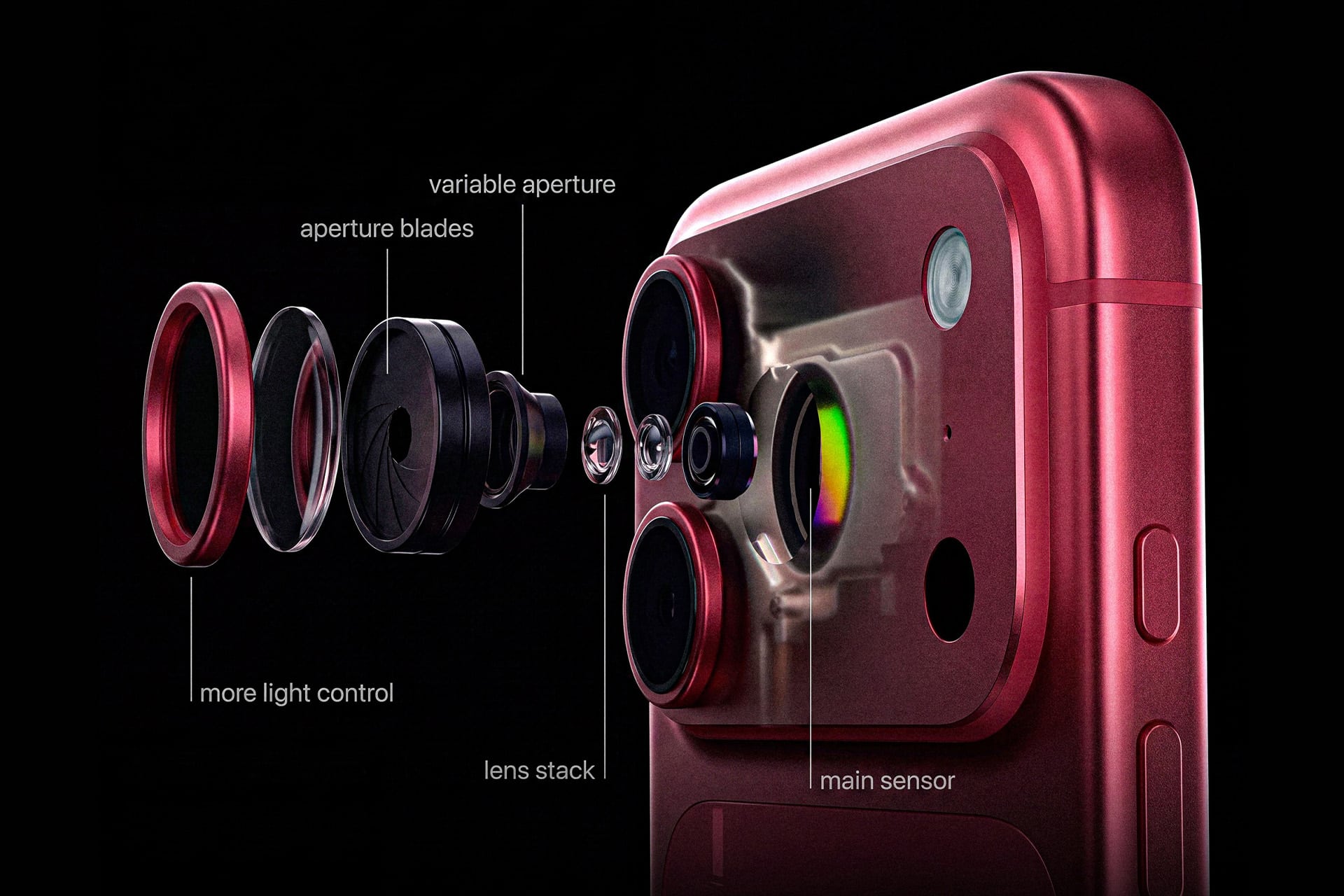
iPhone 18 Pro aperture rumors point to one of the most meaningful camera hardware changes Apple has considered in years. The iPhone has always relied on fixed-aperture lenses, leaving exposure, blur, and low-light behavior mostly to sensor design, image processing, computational photography, and software controls. A physical variable aperture would add a mechanical layer of camera control that iPhone photography has never had before.
The rumor has appeared across several supply-chain and leaker reports. Ming-Chi Kuo has said the iPhone 18 Pro and iPhone 18 Pro Max are expected to use a variable aperture lens on the main camera, with Sunny Optical supplying a large share of the component. ETNews has also reported that Apple’s supply chain has started preparing for the new camera system. Digital Chat Station has pointed to variable aperture as part of Apple’s next Pro camera plan.
Apple has not announced the feature. The current iPhone 17 Pro uses a 48MP Fusion Main camera with a fixed ƒ/1.78 aperture, according to Apple’s technical specifications. That aperture does not physically change between bright daylight, indoor scenes, portraits, night shots, landscapes, and close-ups. The camera adapts through shutter speed, ISO, sensor processing, HDR, lens selection, and computational depth effects.
A variable aperture would change that relationship. Instead of using one fixed lens opening for every scene, the iPhone 18 Pro could physically adjust how much light reaches the sensor.
What a Physical Aperture Does
Aperture is the opening inside a camera lens that controls how much light reaches the sensor. A wider aperture, represented by a lower f-number, lets in more light and creates shallower depth of field. A narrower aperture, represented by a higher f-number, lets in less light and keeps more of the scene in focus.
On traditional cameras, aperture is one of the core creative controls. It affects exposure, background blur, subject separation, sharpness across the frame, and the balance between motion blur and noise. Smartphones have mostly avoided true aperture control because the lens modules are tiny, space is limited, and moving parts add complexity.
The iPhone has solved many camera problems through computation. Portrait mode simulates background blur. Night mode combines multiple frames. Smart HDR balances highlights and shadows. Photonic Engine processing improves detail and color. Those tools are powerful, but they work around a fixed physical lens.
A variable aperture would give the camera system another starting point. Instead of trying to solve every scene after capture, the camera could adjust the lens before capture.

Why It Could Improve iPhone Photos
The clearest benefit is light control. In darker scenes, a wider aperture lets more light hit the sensor. That can help the camera use a faster shutter speed, lower ISO, or both. The practical benefit is cleaner low-light photos, less motion blur, and better handheld results when people or pets are moving.
In bright light, a narrower aperture can help avoid overexposure and keep more of the scene sharp. That can be useful for landscapes, architecture, group photos, street scenes, product shots, and travel images where the user wants foreground and background detail instead of heavy blur.
A physical aperture also gives the camera more control over depth of field. The iPhone already creates convincing portrait blur through software, but computational blur has limits. Hair, glasses, transparent objects, pets, hands, and complex edges can confuse depth maps. A real optical depth effect gives the camera more natural subject separation before software enhancement begins.
That does not mean software portrait mode becomes irrelevant. It means Apple could combine optical depth with computational depth. The camera could capture a more natural base image, then refine blur, subject edges, and background rendering with software.
For video, aperture control could be even more useful. Video is less forgiving than still photography because exposure shifts and blur behavior happen continuously. A physical aperture could help the iPhone handle changing light while preserving more natural motion and depth. It could also support more cinematic background separation without relying entirely on software effects.
The Smartphone Size Problem
A variable aperture on iPhone will not behave exactly like aperture control on a full-frame camera. Smartphone sensors and lenses are much smaller, so the depth-of-field effect will be more limited. Even a wide smartphone aperture produces less natural blur than a large camera lens at the same framing.
That is why expectations need to be realistic. The upgrade may not turn the iPhone into a mirrorless camera replacement for portraits. It may instead provide subtle but useful improvements: better exposure flexibility, more natural highlight handling, stronger close-up separation, cleaner indoor shots, and more control for advanced users.
There is also the question of range. Some phones with variable aperture have used only two physical steps, such as wide and narrow. Others have offered more granular control. Apple’s implementation is unknown. A simple two-step system would still be useful if Apple tunes it well, but a more flexible system would give photographers more creative value.
The hardware also has to survive daily use. A physical aperture introduces moving parts inside a device that is dropped, carried, heated, cooled, vibrated, exposed to dust, and used for years. Apple will need the mechanism to work invisibly and reliably.
That is probably why the feature has taken so long to reach iPhone. Apple tends to avoid camera hardware that creates visible fragility or inconsistent behavior.

A More Expensive Lens System
The rumored camera upgrade is not expected to be cheap. Kuo has said the variable aperture lens for the iPhone 18 Pro and Pro Max carries a unit price about 50% higher than a high-end 7P lens. That does not mean the iPhone price rises by the same amount, but it does show why Apple would likely reserve the feature for Pro models.
A more expensive lens has to justify itself inside a crowded camera budget. Apple is already balancing larger sensors, telephoto modules, stabilization systems, LiDAR, coatings, housing design, thermal constraints, and computational photography hardware. Adding a mechanical aperture increases both cost and design complexity.
That makes the feature more likely to appear first on the main camera. The main camera is the most used lens, the one that receives the most engineering priority, and the one where aperture control would affect the widest range of photos.
The iPhone 18 Pro and Pro Max would also give Apple enough pricing room to absorb the feature. A standard iPhone buyer may not notice or pay for physical aperture control. A Pro buyer who cares about camera performance is more likely to understand the value.
Why Apple Would Add It Now
The iPhone camera has become extremely capable, but many recent improvements have been refinements rather than new forms of control. Higher-resolution sensors, better zoom crops, improved processing, and stronger video tools have all helped, but the core lens behavior has stayed fixed.
A physical aperture gives Apple a new camera story that is easy to demonstrate. Show the same scene with more background blur. Show a night photo with less noise. Show a bright landscape with more of the frame sharp. Show video exposure transitions that look smoother and more natural.
It also fits the direction of Pro iPhone photography. Apple has pushed ProRAW, ProRes, Log recording, external recording, advanced camera apps, spatial media, and higher-resolution workflows. A variable aperture would give creators another physical control, closer to traditional camera behavior.
For casual users, Apple can keep everything automatic. The Camera app could choose the aperture based on scene detection, lighting, subject distance, face detection, motion, and capture mode. For advanced users, Apple could expose aperture controls through Pro modes, third-party camera apps, or metadata-aware workflows.
That balance is important. Most people will not want to think about f-stops. They will want better photos. The feature succeeds if automatic mode uses the aperture intelligently without making the Camera app feel more complicated.
Where It Helps Most
Close-up photography may be one of the strongest areas. A wider aperture can create more natural subject separation when shooting food, products, flowers, pets, small objects, and detail shots. Combined with Apple’s processing, this could make close-range photos less flat.
Group photos could benefit from the opposite behavior. A narrower aperture can keep more faces in focus when people are standing at different distances. Current iPhones already use software and small-sensor depth characteristics to keep many scenes sharp, but physical aperture control gives the camera another way to manage focus depth.
Low-light people shots are another target. Night mode can produce bright photos, but moving subjects remain difficult. More light through the lens can help reduce motion blur before the processing stack begins. That could make indoor family photos, restaurants, concerts, pets, and street scenes more reliable.
Video creators could gain from better exposure flexibility. A variable aperture can help manage bright scenes without relying as heavily on shutter speed changes that affect motion rendering. It could also improve transitions between indoor and outdoor lighting if Apple tunes the system carefully.
Portraits may improve, but not only because of blur. The better gain could be more natural falloff between subject and background. Software blur can look impressive, yet optical depth often feels more gradual. Apple could use the physical aperture as the base and computational tools as the polish.
The Manual Control Question
The most interesting software question is whether Apple lets users control aperture directly. The default Camera app has historically kept manual controls limited, while third-party apps such as Halide, Blackmagic Camera, and other pro tools give users deeper control over exposure, focus, format, and capture behavior.
Apple could handle aperture in three ways. It could keep the control fully automatic. It could add a simple “background blur” or “depth” slider that adjusts aperture without exposing f-stop language. Or it could allow direct aperture selection in Pro modes and through developer APIs.
The second option may be the most Apple-like. Instead of asking most users to pick an aperture value, the Camera app could offer clearer creative choices: more background blur, more scene detail, better low light, or automatic. Pro users could still access technical values through advanced apps.
Developer support would be valuable. If Apple opens aperture control through camera APIs, third-party apps could build real manual photography tools around it. That would make the feature more useful for creators who already use iPhone as a serious camera.
The feature would also affect metadata. Photos could include aperture values that reflect real physical lens settings, giving photographers more useful information when editing or comparing shots.
The Risk of Overpromising
Variable aperture sounds more dramatic than it may look in everyday photos. Because iPhone sensors are small, the optical depth difference may be subtle at normal shooting distances. Apple will need to present the upgrade honestly, focusing on practical improvements rather than DSLR-style expectations.
Mechanical complexity is another risk. Any moving camera component must be silent, fast, durable, and consistent. It must work across millions of devices, survive years of use, and not create calibration problems. If the aperture changes slowly, makes noise, affects stabilization, or introduces reliability issues, the benefit becomes harder to defend.
There is also a thickness question. The iPhone 18 Pro camera bump may need more room for the mechanism. Recent leaks already point to larger camera hardware, and a physical aperture could be one reason.
Still, Apple has a history of waiting until a camera feature can be integrated cleanly. The company was not first with telephoto lenses, ultra-wide cameras, night modes, high-resolution sensors, or periscope-style zoom. It usually enters when the feature can be tied to a simple user benefit.
A physical aperture would follow that pattern.
Aperture Could Become the Pro Camera Divider
If the rumor holds, variable aperture could become one of the cleanest differences between Pro and non-Pro iPhones. Many users can understand storage, zoom, and display size, but camera processing can feel abstract. A physical aperture is easier to explain because it connects directly to light and blur.
It also gives Apple a stronger answer to high-end Android phones that already push larger sensors, variable apertures, and manual camera controls. Samsung experimented with mechanical dual aperture years ago on the Galaxy S9 and S10, while several Chinese flagship phones have used more advanced mobile camera hardware since then. Apple does not need to be first; it needs to make the feature feel consistent, durable, and invisible when users do not want to manage it.
The iPhone 18 Pro camera could therefore become less about another megapixel increase and more about giving the lens itself a new job. For years, the iPhone has improved photos by processing fixed-lens images more intelligently. A physical aperture would let the camera start with a better capture decision before Apple’s software takes over.
The first photos to watch will not be staged portraits under perfect light. They will be difficult everyday scenes: a child moving indoors, a dog in a dim room, a restaurant table, a group at different distances, a bright window behind a subject, a night street with mixed lighting, and a close-up where the background should fall away naturally.