

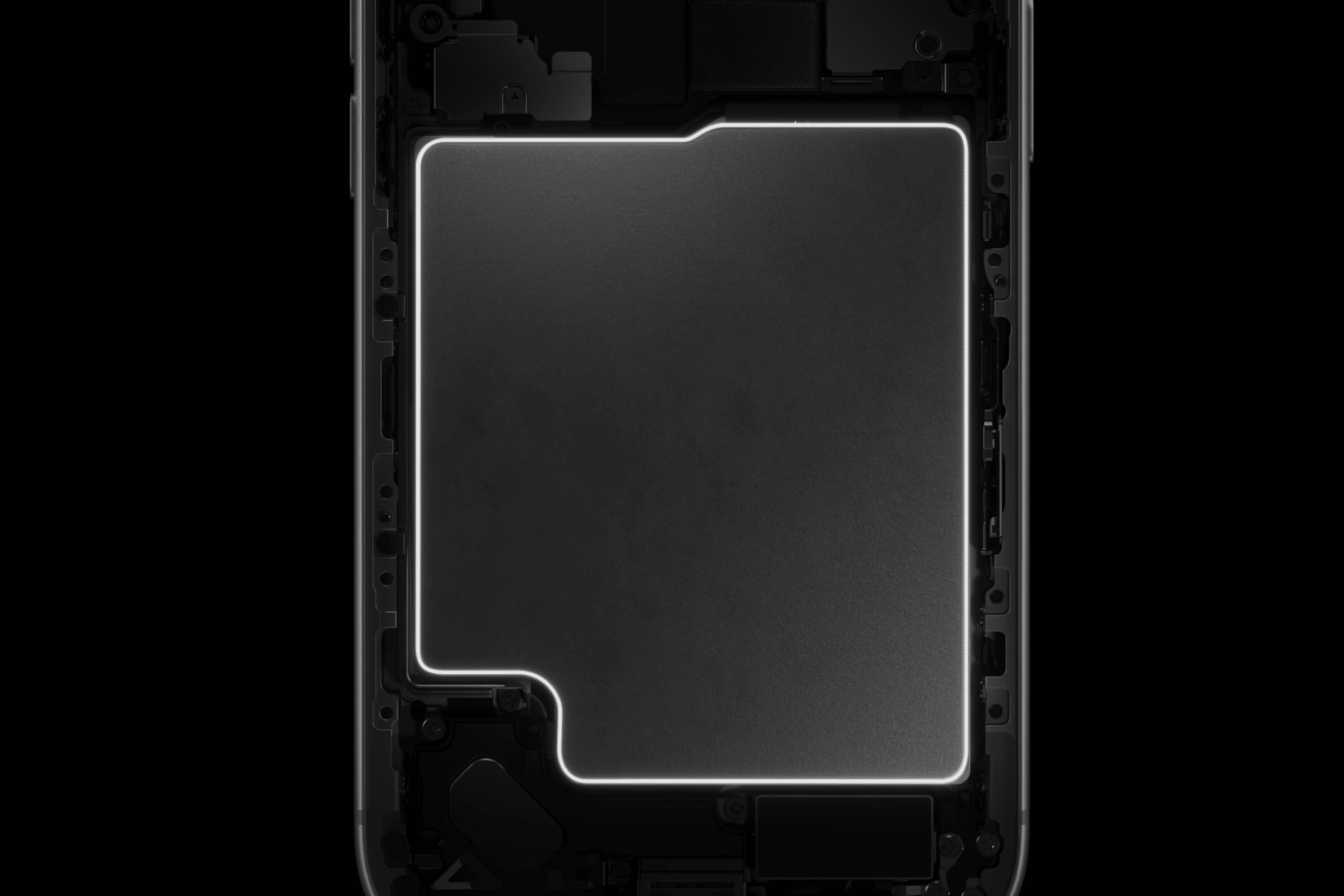
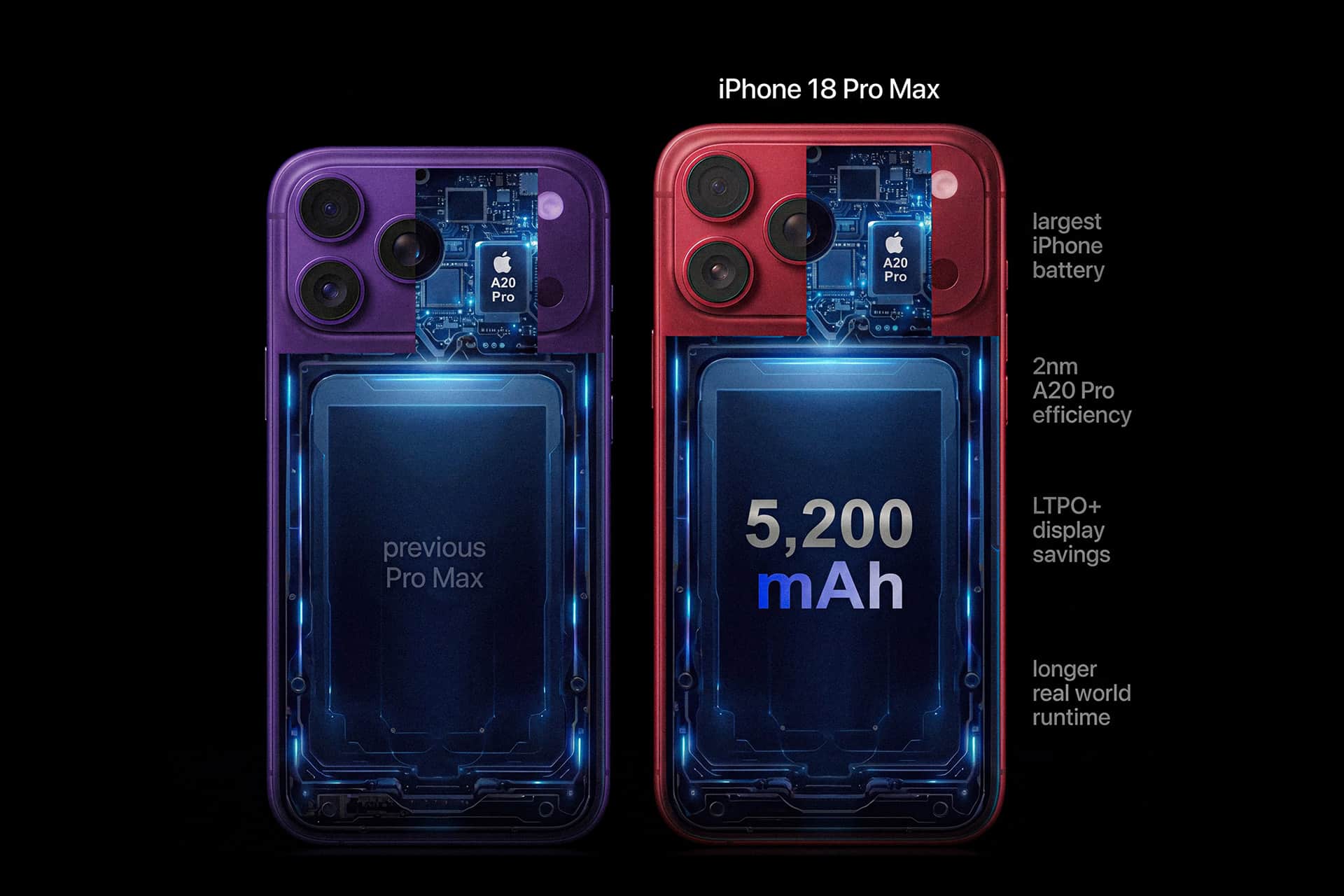
iPhone 18 Pro Max battery leaks suggest Apple is preparing the largest cell ever used in an iPhone, with recent supply-chain claims pointing to a capacity in the 5,100mAh to 5,200mAh range.
The leak comes from Digital Chat Station on Weibo, a source with a track record around Chinese smartphone hardware. The figure would place the iPhone 18 Pro Max above the iPhone 17 Pro Max, which is understood to sit around 5,088mAh in markets where eSIM-only designs give Apple more internal room.
The reported increase is not dramatic by Android standards, where several flagship phones already exceed 5,000mAh. For iPhone, however, the milestone is notable. Apple has traditionally relied on chip efficiency, display tuning, software control, and tight hardware integration rather than chasing the largest possible battery number.
That approach is not changing. The iPhone 18 Pro Max leak points less to a brute-force battery strategy and more to Apple creating extra headroom for heavier flagship workloads.

A Bigger Battery for a Heavier iPhone Era
The iPhone 18 Pro Max is expected to arrive during a period when high-end phones are doing more in the background and more on-device. Camera processing, always-on display behavior, satellite features, mobile gaming, local AI models, video capture, image editing, and modem activity all place pressure on battery life.
That makes a larger cell more valuable than it might have been a few years ago. The Pro Max buyer is not simply browsing, messaging, and taking occasional photos. Many use the device as a camera, travel screen, hotspot, navigation tool, video recorder, gaming device, wallet, work phone, and editing surface.
A move toward 5,200mAh would give Apple more margin for that kind of use. It would also help protect the Pro Max’s identity at a time when the iPhone lineup is expected to stretch in new directions, including the first foldable model above the traditional flagship range.
The Pro Max still needs to be the safest battery choice in the conventional iPhone lineup. A larger cell helps Apple preserve that role while newer form factors take attention elsewhere.
eSIM Models May Keep the Advantage
One of the most useful parts of the leak is the possible regional split. Reports around the iPhone 18 Pro family suggest that eSIM-only versions may receive larger batteries than models that keep a physical SIM tray.
That would follow Apple’s existing hardware logic. Removing the SIM tray frees internal space, and Apple can use that room for battery capacity, structural changes, radio components, or other internal packaging decisions. In the U.S., where iPhones have already moved fully to eSIM, that gives Apple more flexibility than in markets where physical SIM support remains necessary.
The iPhone 18 Pro Max could therefore continue a quiet hardware divide: same product name, slightly different internal layout. A China-market or physical-SIM version may sit closer to 5,000mAh, while eSIM-only versions could move nearer to the 5,100mAh to 5,200mAh range.
Apple is unlikely to market that difference through raw capacity numbers. The company normally presents battery life through usage claims such as video playback, streamed video, and audio playback. Still, the internal split matters because it shows how eSIM adoption is becoming more than a carrier feature.
For buyers, the question may shift from whether eSIM is convenient to whether eSIM-only models quietly become the better hardware versions.
A20 Efficiency Could Matter More Than the Extra Capacity
The iPhone 18 Pro Max is expected to use Apple’s A20 chip, widely rumored to be built on a 2nm process. That transition could have a larger real-world battery effect than the capacity increase alone.
A more efficient chip can reduce power use during common tasks while giving Apple more room for intensive features. Camera pipelines, Apple Intelligence, background analysis, gaming, image editing, video encoding, and display management all benefit when the processor can do more work per watt.
That is especially relevant for a Pro Max model. The largest iPhone usually carries the most demanding camera system, the biggest display, and the longest endurance expectations. If the A20 delivers meaningful efficiency gains, Apple can use the larger battery to extend heavy-use performance rather than simply maintaining the same battery life under more demanding workloads.
This is where the spec sheet can be misleading. A 5,200mAh battery alone does not guarantee a major endurance jump. The gain depends on the display, modem, chip, thermal design, software tuning, and how much new hardware Apple adds around it.
The best-case outcome would be a Pro Max that lasts longer under camera, AI, hotspot, navigation, and gaming use, not only under controlled video playback tests.
Why Thickness Still Matters
The battery leak becomes more interesting if Apple keeps the body near current Pro Max dimensions. Some reports suggest the iPhone 18 Pro Max could remain close to the iPhone 17 Pro Max in thickness, rather than growing noticeably to fit the larger cell.
That would mean Apple is finding capacity through internal redesign, not a larger external shell. Smaller board layouts, improved battery density, eSIM space savings, refined thermal architecture, and component stacking could all contribute.
This matters because the Pro Max is already a large phone. Buyers accept its size because of the screen, camera, and battery, but there is a limit to how much bigger it can become before daily comfort suffers. Apple’s challenge is to increase endurance without making the device feel more difficult to hold, pocket, or use one-handed.
A record battery inside a familiar body would be a stronger achievement than a record battery achieved through extra bulk.
Charging May Stay Conservative
The leak does not point to a major charging-speed change. That is worth noting because larger batteries often lead users to expect faster charging.
Apple has been more conservative than many Android brands on charging speeds, focusing on heat control, battery health, safety, and long-term reliability. A larger Pro Max battery may improve runtime without significantly changing how fast the phone charges from low percentage to full.
That trade-off would fit Apple’s usual priorities. Faster charging can be useful, but it also generates heat. Heat affects battery aging, comfort, and internal component stress. A Pro Max with more capacity can reduce daily charging pressure even if peak charging speed does not move sharply.
The more likely improvement is smarter charging behavior. Apple can adjust background activity, power routing, thermal limits, optimized charging, display refresh, and AI processing to make the battery feel more durable across a full day.
For users upgrading from older Pro Max models, the practical difference may be less about a single headline number and more about fewer late-day battery warnings.
The Pro Max Needs a Cleaner Role
The iPhone 18 generation is expected to be more crowded than recent lineups. With Pro models, a larger Pro Max, and a foldable iPhone expected above the traditional flagship tier, Apple needs each model to have a defined purpose.
The Pro Max can keep a simple promise: the largest conventional iPhone with the best endurance. That remains easy to understand, even if the foldable model becomes the most expensive iPhone.
A bigger battery strengthens that position. It gives Apple a reason to keep the Pro Max attractive for buyers who do not want a foldable design, do not want first-generation hardware risk, or prioritize camera and endurance over a new screen format.
This is also useful for carriers. A record-battery Pro Max is easier to sell than a spec-heavy upgrade. Sales staff can explain it quickly. Buyers can understand the benefit immediately. Battery life remains one of the few smartphone upgrades that does not require education.