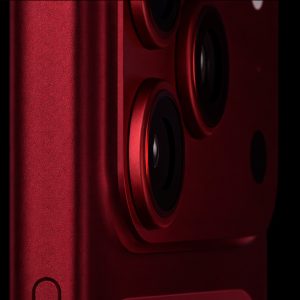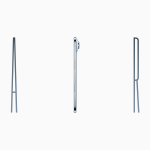
The iPhone Air 2 is emerging as one of Apple’s most ambitious hardware projects in years. Apple has quietly asked its suppliers to create an ultra-thin Face ID module that dramatically reduces the space taken up by the facial recognition system. That space is not being saved for cosmetic reasons. It is being reclaimed so Apple can fit a full ultra-wide camera sensor next to the main camera without making the phone thicker.
This kind of redesign only happens when Apple wants to change what a device can do, not just how it looks.
Inside the iPhone Air 2 Hardware Strategy
Face ID is one of the most complex systems inside an iPhone. It combines infrared cameras, dot projectors, flood illuminators, and a dedicated sensor stack that maps a face in three dimensions. Shrinking this system is far harder than shrinking a normal camera. Every component must maintain alignment, depth accuracy, and security.
Apple’s request to suppliers for an ultra-fine Face ID module signals that the company has reached a point where it can miniaturize this stack without losing performance. That means fewer layers, thinner optical elements, and tighter integration with Apple silicon.
The reward is internal volume — one of the most valuable resources inside any smartphone.

Why Apple Needs That Space
The iPhone Air 2 is designed to remain extremely thin. But Apple also wants to improve photography, especially wide-angle shooting. Ultra-wide sensors take up significant physical space. They require a lens stack, sensor area, and image stabilization hardware.
In previous designs, adding a second large sensor meant increasing thickness or compromising battery size. Apple’s solution this time is to make Face ID smaller so the camera system can grow.
This is a classic Apple tradeoff: shrink one advanced system so another can become better.
What This Means for the Camera
With an ultra-wide sensor added alongside the main camera, the iPhone Air 2 can offer much more flexible photography. Ultra-wide lenses are not just for landscapes. They are increasingly used for video stabilization, spatial capture, group photos, and augmented reality.
A true sensor-grade ultra-wide camera also improves low-light performance and reduces distortion compared to the tiny ultra-wide modules used in older phones.
By making room for this sensor, Apple gives the iPhone Air 2 a camera system closer to what exists in Pro models — without turning the phone into a bulky slab.
Design Without Compromise
Apple’s Air line is built around thinness, lightness, and elegance. The challenge has always been fitting advanced hardware into that slim profile. The new Face ID module is one of the clearest examples of Apple using engineering to solve design limits rather than changing the design itself.
Instead of making the phone thicker, Apple is making the components smarter, tighter, and more integrated.
This also improves reliability. A thinner Face ID stack with fewer layers can reduce misalignment, increase manufacturing yield, and make the system more resistant to shock and temperature changes.

Security Stays Intact
Shrinking Face ID does not mean weakening it. Apple’s security model depends on depth accuracy, infrared mapping, and hardware-level isolation inside the Secure Enclave. The new ultra-fine Face ID system must meet the same biometric standards as current iPhones.
Apple would not trade that away for a camera upgrade. The goal is to preserve Face ID’s security while making it occupy far less space.
This kind of miniaturization is similar to what Apple achieved with the Neural Engine and modem components in recent iPhones.
A Look Ahead
The iPhone Air 2 is shaping up as a statement about where Apple wants its hardware to go. Thinner phones, better cameras, and more internal efficiency — all driven by silicon and optical engineering rather than brute force.
By shrinking Face ID to make room for an ultra-wide camera, Apple is choosing capability over gimmicks. It is a reminder that even in an era dominated by software and AI, the physical design of a device still matters.