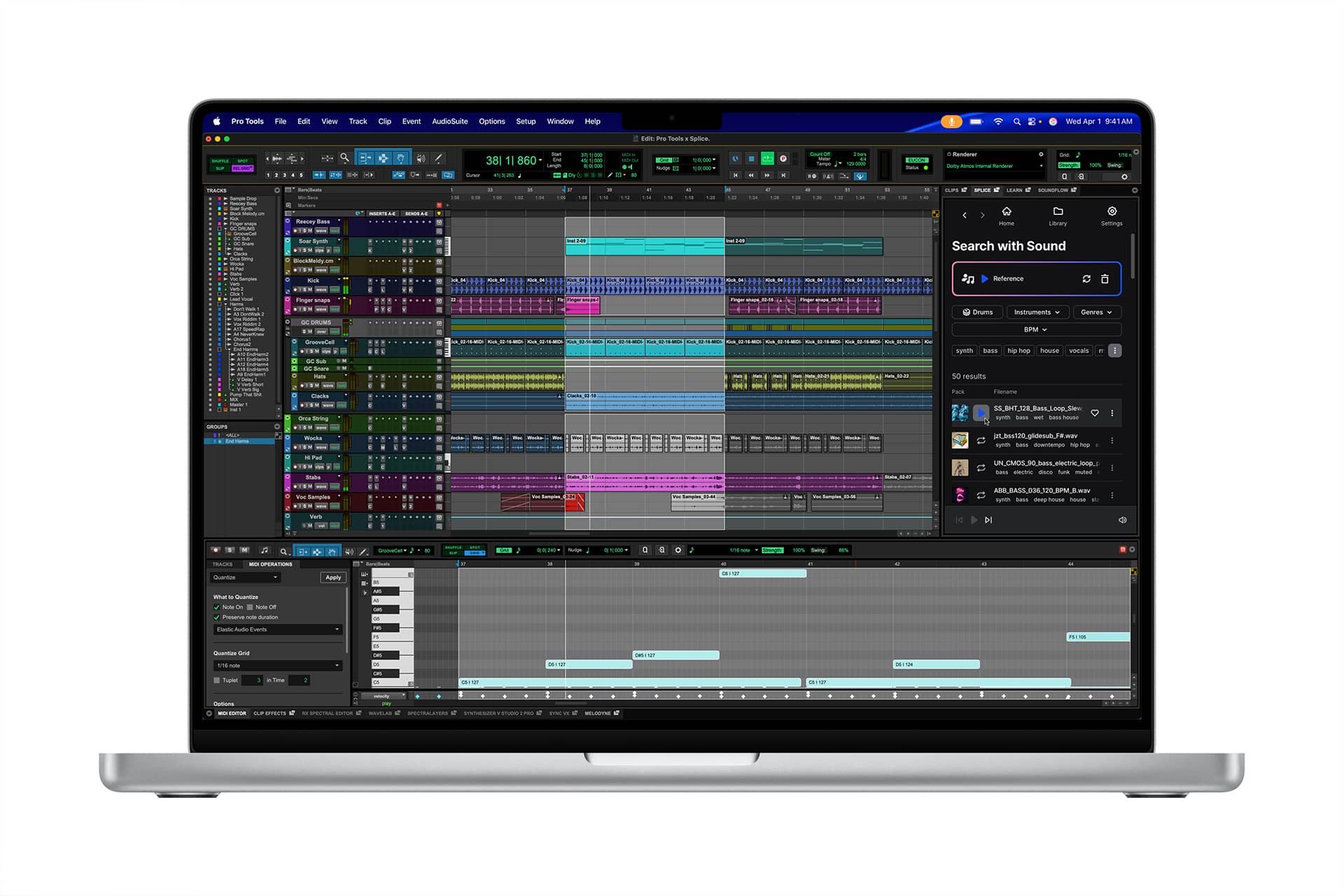
Apple has introduced the M5 chip family, led by M5 Pro and M5 Max, marking a significant architectural evolution in Apple silicon. Built using a new Apple-designed Fusion Architecture, these chips combine two third-generation 3-nanometer dies into a single system on a chip (SoC), scaling performance while maintaining efficiency and unified memory integration.
The M5 chip platform powers the latest MacBook Pro models and focuses on high-end professional workflows, advanced AI processing, and sustained graphics performance.
Fusion Architecture Expands Apple Silicon
M5 Pro and M5 Max debut Apple’s Fusion Architecture, a packaging and interconnect design that links two silicon dies into a single cohesive SoC.
The configuration integrates:
- Advanced CPU cores
- A scalable next-generation GPU
- Unified memory controller
- Media Engine
- Neural Engine
- Thunderbolt 5 controllers
By combining dies with high-bandwidth, low-latency interconnects, Apple increases compute density and memory throughput without compromising power efficiency.
Advanced CPU Design With Super Cores
The M5 chip family features a new 18-core CPU architecture composed of six super cores and twelve redesigned performance cores. The super cores represent Apple’s highest-performing CPU core design, delivering industry-leading single-threaded performance through increased front-end bandwidth, enhanced branch prediction, and a new cache hierarchy.
The additional performance cores are optimized for multithreaded workloads. Together, the CPU architecture provides up to 30 percent higher performance for professional applications compared to the previous generation, and up to 2.5x higher multithreaded performance compared to M1 Pro and M1 Max.
Workloads such as complex simulations, large-scale data analysis, and software compilation benefit directly from this expanded CPU capability.


Next-Generation GPU With Neural Accelerators
The M5 chip introduces a scalable GPU architecture, reaching up to 20 cores on M5 Pro and up to 40 cores on M5 Max. Each GPU core integrates a dedicated Neural Accelerator, dramatically increasing AI compute density.
Apple reports over 4x the peak GPU AI compute compared to the previous generation and over 6x compared to M1 Pro and M1 Max.
The GPU also includes:
- Second-generation dynamic caching
- Hardware-accelerated mesh shading
- Third-generation ray tracing engine
Graphics performance improves up to 20 percent compared to M4 Pro and M4 Max, and up to 35 percent in ray-tracing workflows. This directly benefits 3D rendering, visual effects production, and advanced design simulations.
Unified Memory Bandwidth at Scale
Unified memory remains central to Apple silicon architecture. M5 Pro supports up to 64GB of unified memory with up to 307GB/s bandwidth. M5 Max scales to 128GB with up to 614GB/s bandwidth.
Higher memory bandwidth improves performance for:
- Large language model token generation
- High-resolution video editing
- Massive dataset processing
- Complex 3D scenes
By maintaining a unified memory architecture, CPU and GPU share high-speed access without duplication or bottlenecks.
AI and Neural Engine Enhancements
Both M5 Pro and M5 Max include an upgraded 16-core Neural Engine with a higher-bandwidth memory connection, accelerating on-device AI operations and Apple Intelligence features.
Combined with GPU Neural Accelerators and expanded memory throughput, the M5 chip platform is engineered for local AI workloads, enabling advanced language models, image generation, and agent-based tasks directly on MacBook Pro.
Additional Integrated Technologies
M5 Pro and M5 Max incorporate several advanced system-level technologies:
- Hardware-accelerated H.264, HEVC, AV1 decode, and ProRes encode/decode via the updated Media Engine
- Memory Integrity Enforcement, an always-on hardware-level safety protection
- Thunderbolt 5 controllers integrated directly on the SoC
Each Thunderbolt 5 port is supported by its own custom controller, enabling high-speed external device connectivity and multi-display workflows.
The M5 chip family represents a major expansion of Apple silicon capabilities, combining architectural scale, AI acceleration, memory bandwidth growth, and GPU evolution into a unified platform engineered for demanding professional environments.