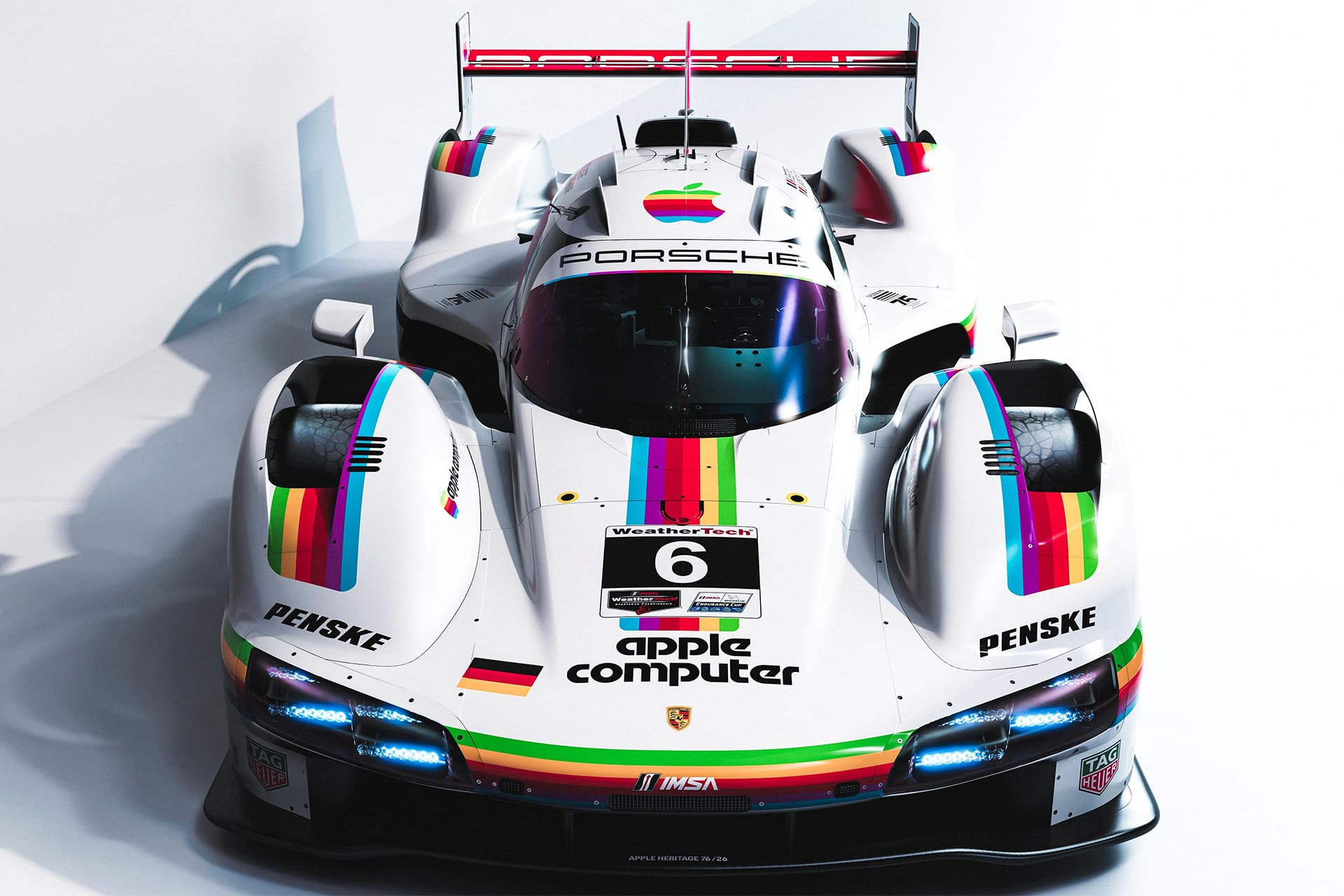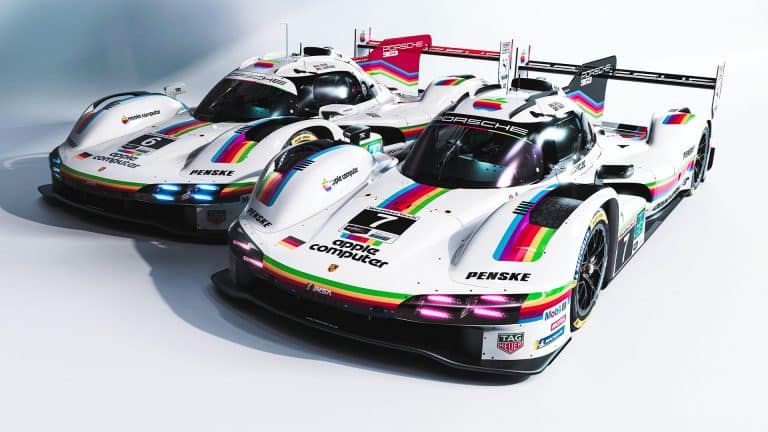
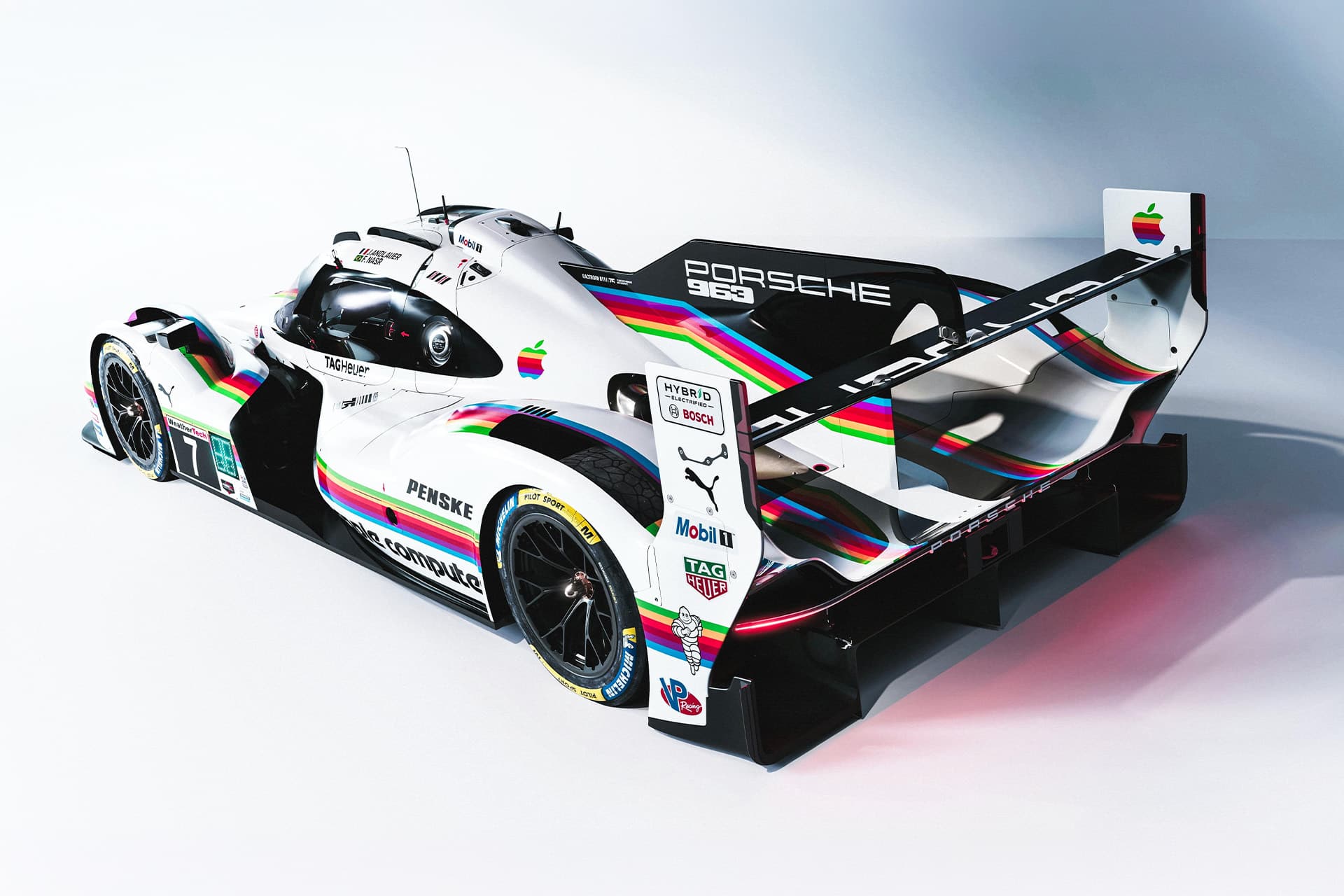
Porsche Apple race car designs are returning to the track in a rare crossover between Silicon Valley history and endurance racing. Porsche Penske Motorsport will run two Porsche 963 prototypes with an Apple Computer-inspired look at WeatherTech Raceway Laguna Seca, where the IMSA WeatherTech SportsCar Championship continues with its fourth round on Sunday, May 3.
The one-race design marks two anniversaries at once: 75 years of Porsche Motorsport and 50 years since Apple was founded in 1976. Porsche says the wrap pays homage to the Apple Computer spectrum livery used on a customer Porsche 935 during the 1980 season, including its appearance at the 24 Hours of Le Mans. The modern version places that color treatment on the factory Nos. 6 and 7 Porsche 963 entries, connecting a current hybrid prototype with a piece of racing design history that has remained familiar to both Porsche fans and Apple collectors.
The setting gives the tribute a strong California link. Laguna Seca sits near Monterey, roughly 80 miles south of Apple’s Cupertino headquarters, and has long been part of Porsche’s public racing culture in the United States. The track has hosted Porsche Rennsport Reunion events and remains one of the most recognizable American road courses, known for its elevation changes and the Corkscrew, a downhill left-right sequence that has become part of motorsport’s visual language.
For AppleMagazine readers, the story reaches beyond a race weekend. Apple’s early rainbow identity has lived for decades as a symbol of the company’s first era, before iPhone, Apple Watch, Apple Vision Pro, Apple Music, and the modern services business. Seeing that look applied to a current Porsche prototype places Apple’s design history into a different kind of performance setting, one shaped by speed, engineering, and visual memory.

A 1980 Porsche Design Returns in Modern Form
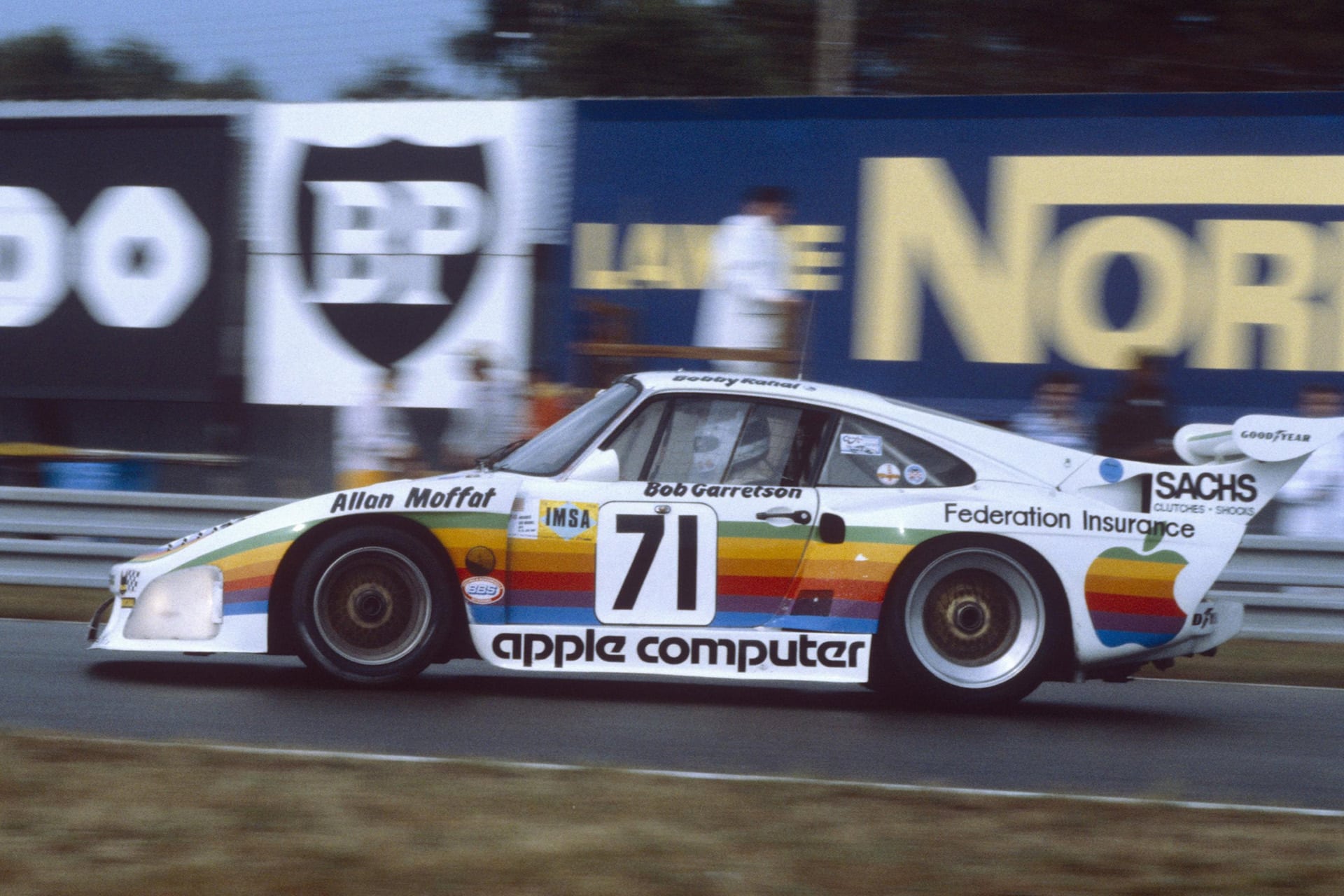
The Porsche Apple race car look is based on a 1980 Porsche 935 K3, a customer race car that carried Apple Computer branding during an era when the company was still closely associated with the Apple II and its early personal computing identity. The original car stood out because its sponsor did not resemble the usual racing brands of the time. Instead of oil, tires, tobacco, or industrial logos, the 935 wore the color language of a young technology company that was still building its place in American culture.
The 935 itself was one of Porsche’s most dramatic race cars. Developed from the 911 Turbo and transformed for competition, the car became known for its wide bodywork, powerful turbocharged performance, and success in endurance racing. The K3 version, built by Kremer Racing, became especially important after winning the 24 Hours of Le Mans in 1979. The Apple Computer-sponsored example from the following season did not achieve the same competitive fame, but its look became a cult reference because of the unlikely pairing.
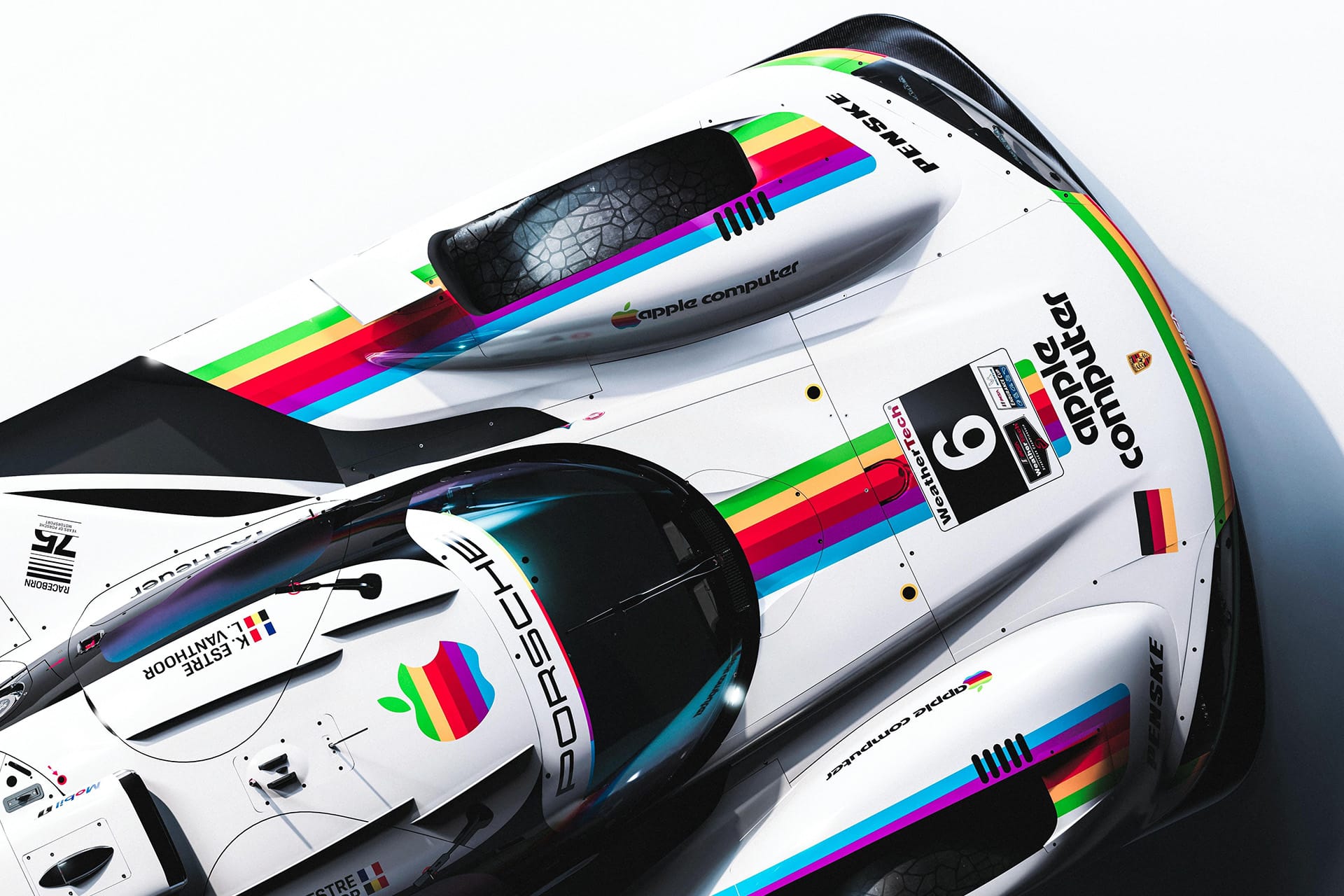
That contrast is what gives the 2026 tribute its character. The Porsche 963 is not a retro machine. It is a modern LMDh prototype developed for top-level sports car racing, with hybrid technology, a low cockpit, sharp bodywork, and aerodynamic surfaces shaped around current regulations. The old Apple Computer color treatment has been adapted to a very different shape, turning the modern car into a bridge between two periods of design.
The new wrap keeps the spirit of the original without making the 963 look like a museum piece. The broad color bands and white base recall Apple’s early spectrum branding, while the prototype’s current racing form keeps the car firmly in the present. That matters because the tribute works best when it is not only nostalgic. It gives Porsche’s current factory program a visual connection to a customer car from the past, while giving Apple’s 50th anniversary a public expression outside the usual world of devices, software, and retail.
Porsche has often used liveries as a way to preserve its own history. Martini stripes, Gulf colors, the Pink Pig, Rothmans designs, and other famous racing schemes are still remembered as clearly as the cars themselves. The Apple Computer 935 belongs to a more niche part of that archive, but its design is instantly recognizable because the rainbow-era identity remains tied to Apple’s early story. Bringing it back on a 963 gives the car a larger audience than a conventional historic reference might have reached.
Laguna Seca Adds a California Stage
Laguna Seca gives the Porsche Apple race car tribute a setting that feels unusually well matched. The circuit is in California, the state where Apple was founded and where Porsche’s American motorsport audience has gathered for generations. WeatherTech Raceway Laguna Seca is also closely tied to Porsche through Rennsport Reunion, the large brand gathering that brings historic race cars, factory drivers, collectors, and fans into the same paddock.
The IMSA weekend itself adds another layer because several teams are using throwback designs at Laguna Seca. Porsche’s entry stands apart because the reference reaches beyond motorsport circles. Many viewers may not know the 1980 Porsche 935 K3, but they know the Apple rainbow colors. That makes the livery easy to understand from a distance while still giving racing fans a deeper historical connection.
Porsche Penske Motorsport will run the design on both factory 963 entries. The team competes in IMSA’s top GTP class against other prototype programs from manufacturers including Cadillac, Acura, and BMW. The 963 has become Porsche’s main car for the current endurance racing era, competing in North America and internationally as the company continues to build around hybrid prototype rules.
The design also follows another recent Apple-linked Porsche appearance. Porsche Penske Motorsport ran an Apple Music-inspired livery earlier in the 2026 IMSA season at Long Beach, tying the cars to Apple’s current services identity. Laguna Seca moves the connection backward in time, from Apple Music’s modern branding to the Apple Computer colors associated with the company’s early decades. The two liveries sit in different eras of Apple’s identity, but both place the company’s visual language in front of racing audiences.
Porsche has also linked Apple to its road cars through digital experiences. Apple Music integration has appeared inside Porsche vehicles, and Porsche has been part of the broader conversation around deeper Apple software experiences in the car. A race livery is different because it does not sit inside an infotainment screen. It turns the relationship into something physical, public, and temporary.
The temporary nature is part of the appeal. Porsche says the Laguna Seca wrap is a one-time design. That makes the May 3 race the only scheduled appearance for the Apple Computer-inspired 963s. One-off liveries often become more memorable than full-season designs because they are tied to a single event. They create photos, model cars, collector interest, and social media attention that live beyond the race result.
The fact that the event is at Laguna Seca also gives Apple’s anniversary a more local frame. Apple’s founding is usually told through garages, early computers, design studios, retail stores, and product launches. This tribute adds a different image to that anniversary year: two Porsche prototypes racing in California while wearing colors that trace back to the company’s first widely recognized identity.
A Rare Crossover Between Apple History and Racing
The Porsche Apple race car tribute works because it has a real historical reference behind it. It is not simply a modern marketing wrap using familiar colors. The original Apple Computer Porsche existed, raced, and became a small but memorable part of motorsport design culture. The 2026 version returns to that source and gives it a new scale through Porsche’s factory prototype program.
The pairing also makes sense because both brands have long depended on design as much as performance. Porsche race cars are remembered for engineering, but their liveries often become part of the emotional record. Apple products are remembered for function, but the company’s identity has always been tied to how technology looks, feels, and fits into everyday life. The 963 wrap brings those two design languages into one frame.
Apple’s rainbow identity has a different meaning today than it did in 1980. At the time, it helped make a young computer company feel more human and accessible. Decades later, it has become a shorthand for early personal computing, creative culture, and the pre-iPhone years of Apple’s history. On a Porsche prototype, those colors do not need much explanation. They immediately point to an earlier Apple while still feeling graphic enough for a modern racing car.
The design also arrives at a moment when Apple’s brand is spread across far more surfaces than the original Apple Computer era could have suggested. Apple is now part of phones, watches, tablets, laptops, payments, streaming, fitness, gaming, automotive interfaces, and spatial computing. A Porsche 963 wearing an Apple Computer-inspired design is a reminder that the company’s oldest visual identity still carries enough recognition to work on an entirely different kind of machine.
For Porsche, the tribute adds another chapter to a motorsport anniversary year built around memory, continuity, and competition. The company’s racing history stretches back to 1951, and its cars have shaped endurance racing across Le Mans, Daytona, Sebring, IMSA, and other major events. Connecting a current factory prototype to a customer 935 from 1980 gives the anniversary a more specific texture than a general celebration could provide.
The Laguna Seca race will decide points in the IMSA season, but the Apple Computer-inspired 963s will likely be remembered first for how they look. That is not unusual in racing. Some cars become famous because they win, some because they represent a technical leap, and others because a certain design captures the right moment. Porsche’s Apple tribute belongs to that last group, with a modern prototype carrying a set of colors that started in the personal computer age and returned to the track for one California weekend.