Siri Extensions may become Apple’s next major developer battleground because the future of the iPhone is moving from opening apps to asking for outcomes. If iOS 27 lets users choose third-party AI models for Apple Intelligence tasks, and if Siri becomes more capable at calling app actions through App Intents, developers will no longer compete only for home-screen placement or App Store ranking. They will compete for a place inside the assistant layer.
That is a major shift. The App Store made apps the center of mobile software. Siri Extensions could make actions the next center. A user may not open a travel app, finance app, fitness app, calendar app, photo app, or shopping app directly. They may ask Siri to change a booking, compare expenses, log a workout, summarize a document, edit an image, or complete a task. The assistant then decides which model, app, and system action should respond.
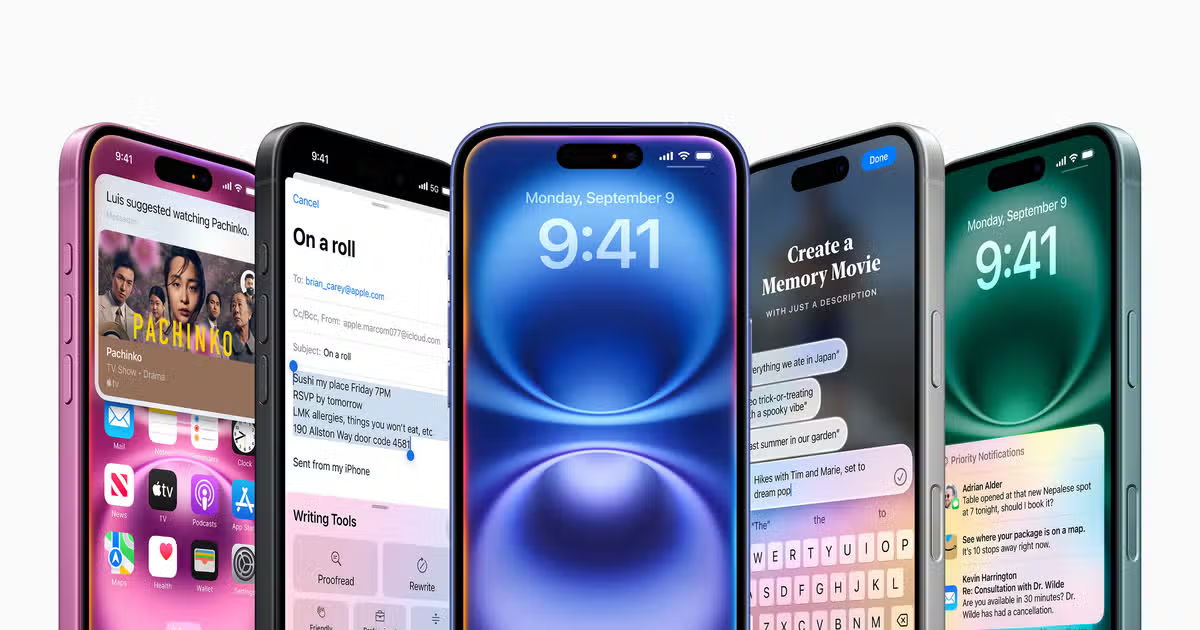
Apple is reportedly preparing an “Extensions” system in iOS 27, iPadOS 27, and macOS 27 that would let users select third-party AI models for tasks such as text and image generation. Reports say Apple has tested integrations with Google and Anthropic, while ChatGPT is already part of Apple Intelligence for certain requests. Apple’s own developer materials already point in the same direction: App Intents lets apps expose capabilities and content to Siri and Apple Intelligence, while Foundation Models lets developers bring Apple’s on-device model into their apps.
Together, those pieces show Apple’s likely strategy. Siri becomes the interface. App Intents becomes the action layer. Foundation Models brings private on-device intelligence into apps. Third-party AI models become optional providers for certain tasks. Developers who adopt the right frameworks early may become easier for Siri and Apple Intelligence to find, understand, and use.

Apps Will Compete Through Actions
Siri Extensions matter because they change what it means for an app to be useful. In the old model, an app had to convince the user to open it. In the next model, an app may need to expose the right actions so Siri can use it when the user asks for help.
That is where App Intents becomes central. Apple’s framework gives developers a way to describe what their apps can do, define actions, expose content, and connect those capabilities to system experiences. Siri, Spotlight, Shortcuts, widgets, controls, and Apple Intelligence can then understand those actions more clearly.
For developers, this is not only a technical upgrade. It is a distribution challenge. If a food delivery app exposes strong ordering actions, Siri may be able to help a user reorder a favorite meal. If a finance app exposes spending categories, Siri may help summarize expenses. If a travel app exposes itinerary changes, Siri may help adjust a reservation. If a productivity app exposes document actions, Siri may help organize or rewrite work without the user opening the app first.
The apps that do not expose their capabilities may become less visible in an assistant-first interface. They may still exist on the Home Screen, but they could lose moments when users ask the system to complete tasks directly. That makes Siri Extensions a new kind of platform competition.
This also changes design priorities. Developers will need to think less about only screens and more about intents, entities, permissions, summaries, and safe actions. The question becomes: what can the app do for the user when the user does not want to open the app?
Third-Party Models Add Another Layer
Siri Extensions could become more competitive if Apple lets users choose outside AI models for different Apple Intelligence tasks. A user may prefer one model for writing, another for image generation, another for coding, and another for conversational answers. That choice would turn Apple Intelligence into a more open layer while keeping the experience inside Apple’s controlled system.
For developers, this creates a more complex but more powerful environment. An app may use Apple’s Foundation Models for private on-device features, rely on its own cloud AI for specialized tasks, and also work with Siri when the user chooses Gemini, Claude, ChatGPT, or another supported model for certain requests. The assistant layer becomes a meeting point between Apple’s frameworks, third-party models, and developer apps.
Apple benefits from this structure because it does not have to win every model race alone. It can own the interface, privacy prompts, system permissions, device context, and app-action framework. Outside models can compete on capability, while developers compete on how well their apps expose useful actions.
That is a very Apple-like compromise. The company can look more open without giving up full control of the user experience. Users get model choice. Developers get new integration points. Apple keeps the operating-system layer where everything comes together.
The risk is complexity. If users have to manage too many models, voices, app permissions, and extension settings, the system could feel messy. Apple will need to make the defaults work well while giving advanced users enough control to choose their preferred AI providers.


Developers Need to Prepare Before Siri Changes
Siri Extensions could create a fast divide between apps that are ready for assistant-driven workflows and apps that are not. The developers most prepared for this shift will likely be the ones already investing in App Intents, Shortcuts, Spotlight integration, widgets, controls, and clear app data models.
That preparation matters because AI assistants need structure. A model can understand language, but it still needs safe, reliable actions. It needs to know what a user is allowed to do, which data belongs to the app, which action requires confirmation, and what information should remain private. App Intents gives developers a way to make those boundaries clear.
Foundation Models adds another opportunity. Apple says developers can use the on-device model behind Apple Intelligence to build private, offline-capable intelligent features at no cost per request. That could be especially useful for smaller developers that cannot afford large cloud AI bills. A journaling app, study app, writing app, habit tracker, finance app, health-adjacent app, or productivity tool could add summarization, suggestions, categorization, and natural-language features without sending every request to a remote server.
This could become one of Apple’s strongest developer advantages. Rival platforms may offer more open AI access, but Apple can offer a tightly integrated stack where privacy, device performance, and system features work together. The developers who use that stack well may gain a better position inside Apple Intelligence.
The New App Store Battle Moves Above the App Store
Siri Extensions may eventually become as important as App Store search because the assistant layer can shape which apps users discover and use. In an AI-driven iPhone, the user may not browse categories or search for an app at all. They may ask Siri to do something, and the system may surface the app or action that best fits.
That creates new questions. How does Siri choose between apps that offer similar actions? Will Apple’s own apps get priority? Can developers pay for placement? Will users be able to choose default apps for specific AI tasks? Can rival assistants access the same App Intents? How will Apple explain when a third-party model is answering instead of Apple’s own system?
Those questions make Siri Extensions a regulatory issue as much as a developer issue. The European Union is already looking more closely at AI assistants, cloud services, and gatekeeper rules. If Siri becomes the main path to apps and services, regulators may examine whether developers and rival AI providers receive fair access.
Apple’s best defense is a system that feels fair, private, and transparent. Developers should have clear rules for exposing actions. Users should know when outside models are used. Apple should avoid making its own apps feel artificially privileged inside Siri results. That will be difficult, but it may be necessary if Siri becomes the next platform layer.
Siri Extensions could turn iOS 27 into a new chapter for Apple developers. The first App Store battle was about getting an app installed. The next battle may be about making an app available to the assistant at the exact moment a user asks for something. For Apple, that is the smartest way to enter the AI race: not by replacing apps, but by making every good app part of Siri’s intelligence.