

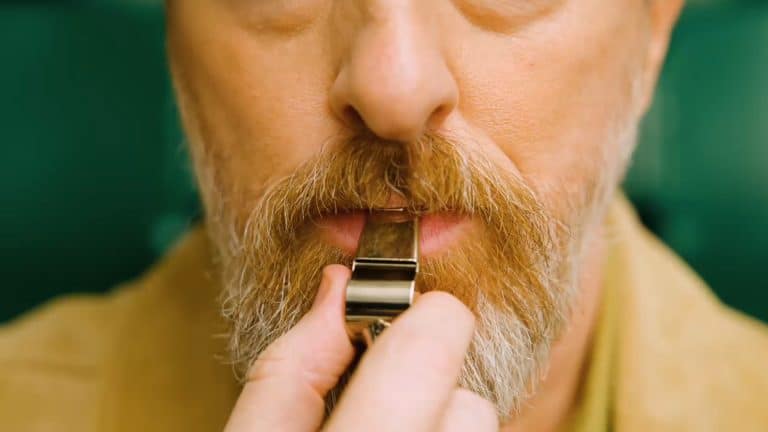
After the Whistle is returning at the right time for Apple’s expanding sports strategy. Apple News announced that the podcast hosted by Brendan Hunt and Rebecca Lowe will return June 7 for a third season, with coverage centered on the upcoming World Cup. The show will be available in audio and video on Apple News, Apple Podcasts, and other podcast platforms, with new episodes arriving multiple times a week after major games.
The return gives Apple a recognizable voice around one of the largest sports and cultural events in the world. Hunt brings the Apple TV connection through “Ted Lasso,” where he played Coach Beard and served as cocreator of the Emmy Award-winning series. Lowe brings the broadcast authority, with years as host of NBC Sports’ Premier League coverage and a role as cohost of FOX Sports’ FIFA World Cup 2026 coverage. Together, they give Apple something more personal than scores, brackets, and match recaps: a conversational companion for the tournament.
That matters because Apple is no longer treating sports only as live rights or app updates. The company is building a connected sports layer across Apple News, Apple Sports, Apple Podcasts, Apple TV, and iPhone features such as Live Activities. “After the Whistle” sits neatly inside that strategy. It gives fans a show to return to after the match, while Apple News and Apple Sports handle schedules, scores, brackets, lineups, and favorite-team tracking.
Apple says the first episode will focus on tournament previews, with the season running throughout the World Cup. The trailer is already available on Apple News and Apple Podcasts, and the show is produced by Apple News and presented by Verizon.

Apple News Gets a More Human Sports Layer
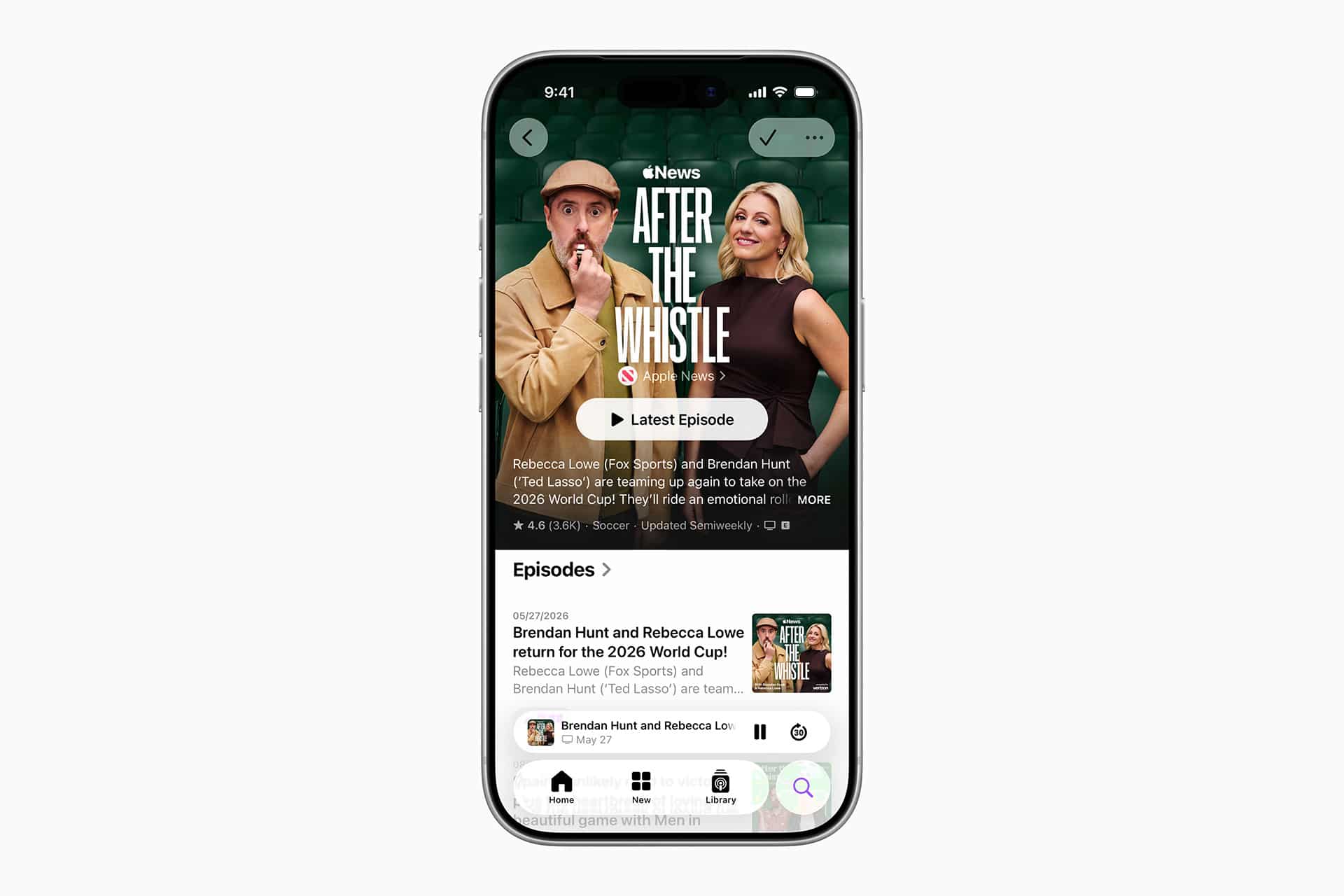
After the Whistle gives Apple News a personality-driven sports product at a time when sports coverage is becoming more integrated across Apple’s services. Apple News already offers a Sports feed where users can follow teams and leagues, receive stories from publishers, access scores, schedules, standings, notifications, and watch highlights in the News app. For the World Cup, Apple says News will provide the latest reporting and analysis from top publishers, tournament schedules, scores, brackets, player-focused feeds, and the ability to follow favorite teams.
That is the utility side. A podcast adds the human side.
The World Cup is not only about results. It is about emotion, national identity, tension, surprise, disappointment, celebration, rivalry, and the stories around the pitch. Hunt and Lowe are well suited to that tone because their pairing mixes fandom, humor, experience, and broadcast fluency. Apple’s announcement leans into that emotional quality, with both hosts describing the tournament as an unpredictable ride.
For Apple News, this helps turn sports coverage from a feed into a habit. A user may read match analysis, check a bracket, follow a team, and then listen to “After the Whistle” after a key game. That gives Apple more than one touchpoint around the same event.
Apple Sports Completes the Match-Day Utility
After the Whistle also connects naturally with Apple Sports. Apple recently expanded Apple Sports to more than 90 additional countries and regions, bringing the app to more than 170 countries in total. The timing was clearly tied to World Cup 2026, with Apple adding tournament-focused features such as bracket views, enhanced game pages, visual lineup formations, real-time play-by-play, in-depth stats, and Live Activities for compatible devices.
Apple says users’ favorite teams and leagues sync across Apple News, Apple Sports, and Apple TV. That syncing is important because it turns sports interest into an ecosystem preference. A fan who follows a national team in Apple Sports can see related coverage in Apple News and relevant viewing or sports surfaces in Apple TV.
“After the Whistle” fits into that loop. Apple Sports gives the live and postgame data. Apple News gives written coverage and publisher analysis. Apple Podcasts gives commentary and personality. Apple TV gives video and sports programming. The user does not need to think of these as separate services. Apple is trying to make the tournament feel like one connected experience across iPhone and its media apps.
This is the kind of sports strategy Apple can pursue even when it does not own every live match. It can still own parts of the fan experience.
Brendan Hunt Keeps the Ted Lasso Bridge Alive
After the Whistle benefits from Brendan Hunt because he carries a natural Apple TV connection. “Ted Lasso” remains one of Apple TV’s most important originals, and its relationship with soccer gives Apple a softer cultural bridge into World Cup coverage. Hunt’s presence gives the podcast a recognizable Apple entertainment link without making the show feel like a scripted-series promotion.
That bridge is useful because Apple’s soccer identity has grown across several areas. Apple TV carries Major League Soccer through MLS Season Pass. Apple Sports is expanding global soccer features. Apple News is building World Cup coverage. Apple has used soccer repeatedly as a way to connect sports, entertainment, and services.
Hunt is not positioned as a traditional analyst. That is why the pairing with Lowe works. Lowe provides the broadcast anchor and soccer expertise. Hunt provides the fan lens, humor, and Apple TV connection. The show can talk about serious match moments without sounding like a standard postgame studio desk.
That tone may be especially useful during a long tournament. Fans already have access to highlights, analysis, match reports, and tactical breakdowns from many outlets. Apple’s podcast needs to feel like a companion, not just another recap.
Video Podcasts Give Apple Another Surface
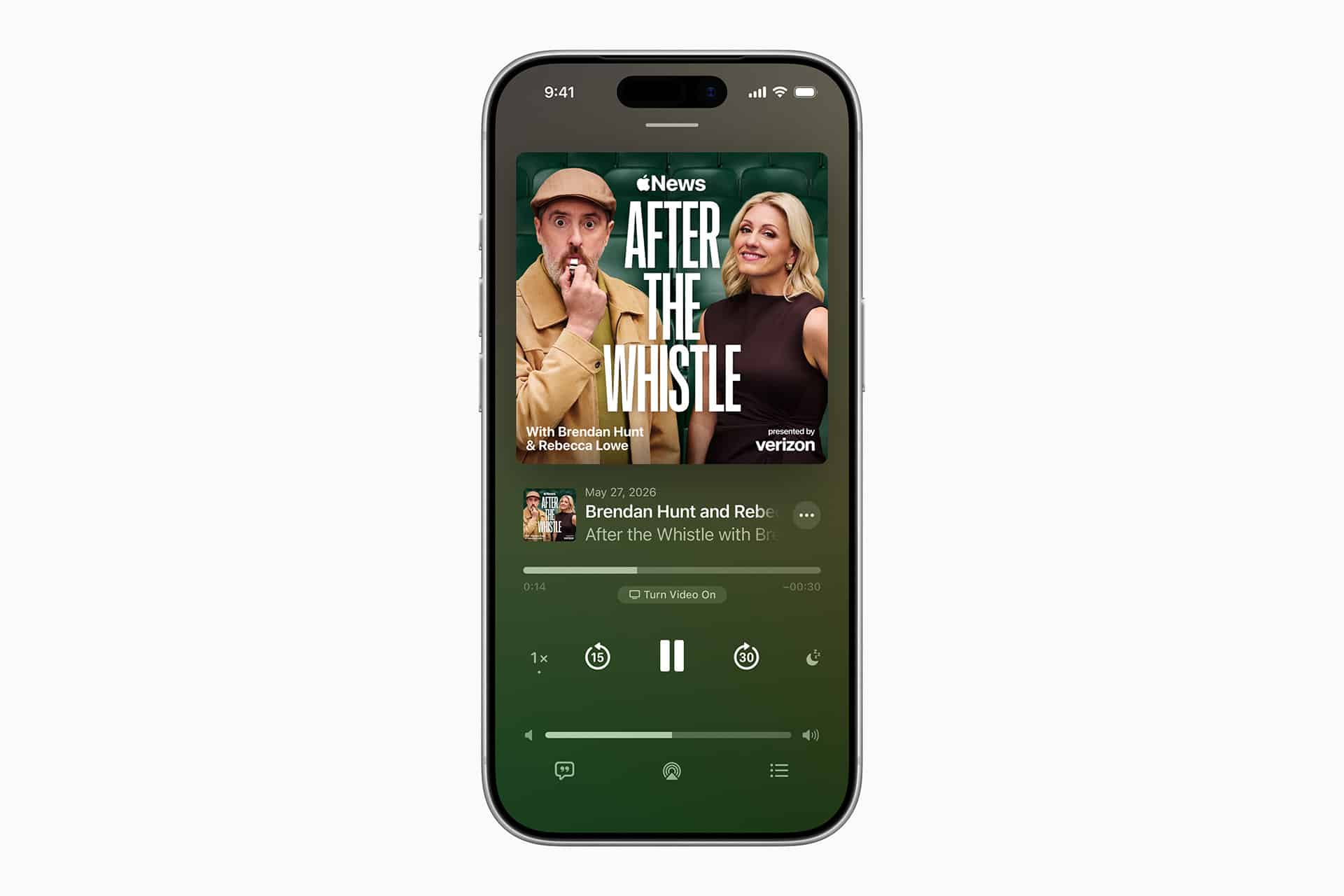
After the Whistle being available in both audio and video also matters. Apple Podcasts has been expanding video podcast support, and Apple News can present the show visually inside its own app. Sports commentary can work well in video because hosts’ reactions, expressions, clips, and conversational chemistry add value beyond audio.
For Apple, video podcasts are another way to keep users inside its media ecosystem. A fan can watch on iPhone, iPad, Mac, Apple TV, or listen through AirPods. Video also makes the show easier to promote across social media, Apple News, and Apple TV-related surfaces.
This is a smaller but important part of Apple’s Services strategy. Audio, video, written coverage, live scores, and sports apps can reinforce one another. “After the Whistle” gives Apple content it owns and can distribute across several of those surfaces.
A World Cup Strategy Without Owning the Whole Tournament
After the Whistle shows how Apple can participate in the World Cup without being the primary rights holder for live matches. Apple does not need to control every broadcast to create a meaningful sports experience. It can provide context, conversation, scores, schedules, brackets, notifications, favorite-team tracking, podcasts, and connected app experiences.
That is a useful model for Apple. Sports rights are expensive and often locked in long-term deals. Apple can be selective with live rights, such as MLS, Friday Night Baseball, and Formula 1 in the U.S., while still building services around major global events through News, Sports, Podcasts, and TV.
The World Cup is ideal for that approach because the event creates daily attention across weeks. Fans want to know what happened, what is next, who advanced, who was injured, which teams surprised, and why a match mattered. Apple can meet those needs through several apps even if the live match itself airs elsewhere.
“After the Whistle” gives the strategy a voice. Apple Sports provides the scoreboard. Apple News provides the reporting. The podcast provides the emotional recap after the final whistle.
A Stronger Services Play Around Soccer
After the Whistle returns as Apple’s sports ecosystem becomes more coordinated. The company is clearly using soccer as one of the main ways to grow engagement across services. MLS gave Apple a year-round soccer product. World Cup features in Apple Sports give the app a global tournament moment. Apple News gives fans written coverage and team-following tools. Apple Podcasts adds a recurring show with familiar hosts.
This does not make Apple a traditional sports network. It makes Apple a sports companion platform. The difference matters. Apple may not always own the live rights, but it can still make iPhone the place where fans organize, follow, react, and return.
For the World Cup, that approach is practical. A fan can follow teams in Apple Sports, read stories in Apple News, receive Live Activities during matches, watch supported content through Apple TV where available, and then listen to Hunt and Lowe after major games. Apple is trying to make the tournament easier to follow without requiring fans to rebuild their habits around separate apps.
That is why the third season of “After the Whistle” is more than a podcast renewal. It is part of Apple’s effort to turn sports interest into a connected Services experience.